Interview with artists Jenny and Sam Dowd
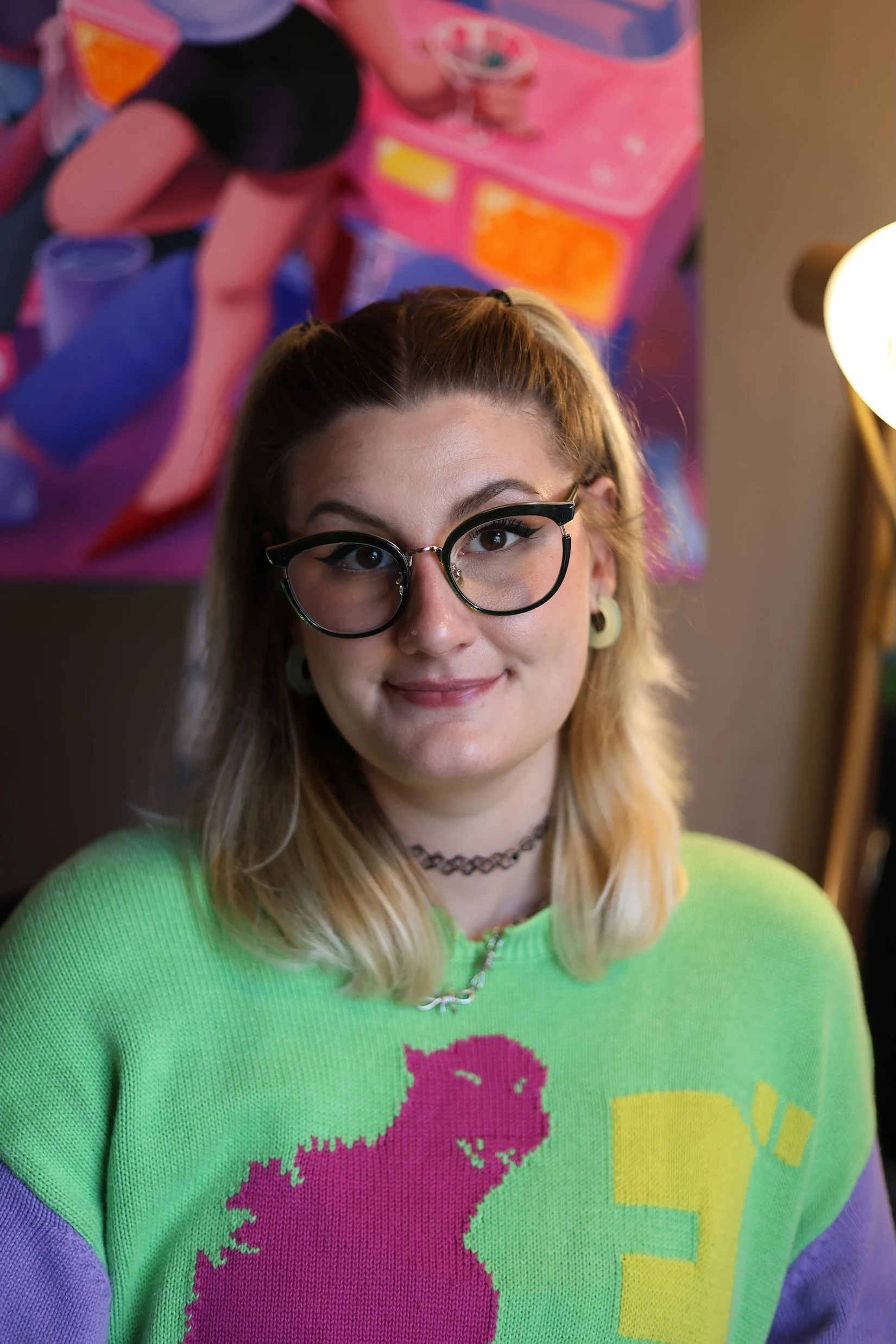
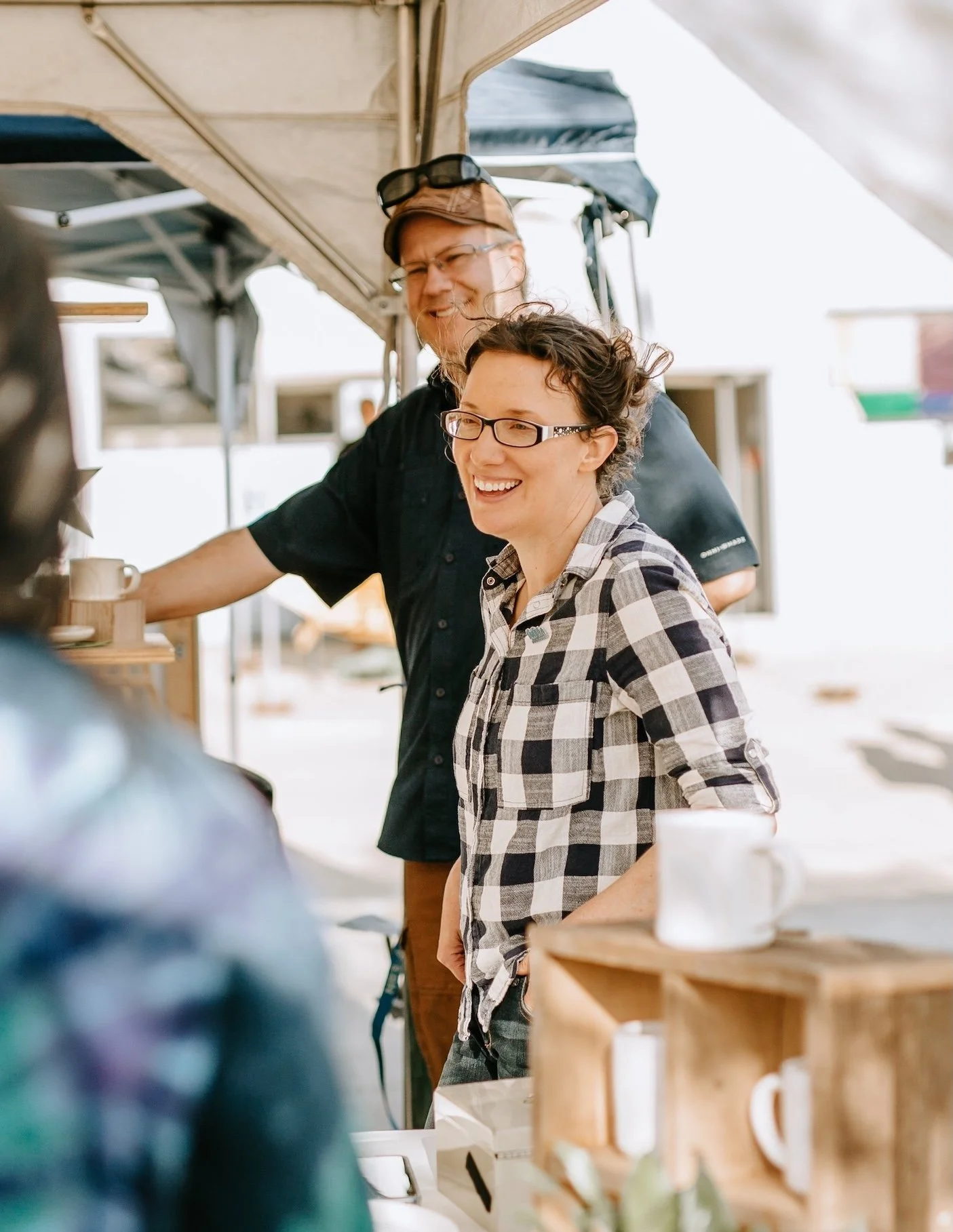
Jenny and Sam Dowd are ceramicists and sculptors and owners of Dowd House Studios in Prairie Grove, Arkansas. They met at Kansas State University where Sam was earning an MFA and Jenny a BFA. After graduation they move to the University of Missouri-Columbia, where Jenny earned a MFA. After working as potters and teachers in Wyoming for almost 15 years, they relocated to Northwest Arkansas and set up their current studios. More of their work can be found at dowdhousestudios.com. (Profile photo by Millie Cooper)
AAS: Jenny and Sam, how did the two of you meet?
JD: I was working on a BFA in ceramics at Kansas State University. This guy kept showing up and we laughed so much, it felt like I’d known him forever. We exchanged phone numbers on pieces of clay, which I actually still have. Sam was a grad student and I was just starting to think about graduate school, so getting to know him helped solidify that plan for my future. While at KSU I worked as the registrar’s assistant at the Beach Museum of Art and also taught pottery classes at the Parks and Rec. When I declared my major in art, I set a goal for myself – every job had to be in the field of art. The strangest job might be cleaning the outdoor sculptures at the National Museum of Wildlife Art in Wyoming.
Sam and I graduated at the same time, married that summer, and in the fall, I started graduate school at the University of Missouri-Columbia. We heard a million warnings about relationships during college, but we found out that we make a great team, supportive and also independent.
After graduation we started the adjunct hop – I taught at the University of West Georgia and the University of Central Missouri. Then we moved to Wyoming for Sam’s job at the Art Association of Jackson Hole. I worked there for 5 years as a volunteer coordinator, then gallery manager, and education manager for the painting, drawing, and printmaking studio. Little did I know that I would also build the business that would give us the opportunity to become independent.
SD: I earned a BFA at the University of Nebraska Kearney and an MFA at Kansas State University. Yes, we met in the ceramics studio and yes, I gave her my number written on a piece of clay and the rest is history. After graduating and moving to Missouri with Jenny, I found adjunct work teaching a wide variety of art classes including ceramics, sculpture, color theory, and art appreciation at Moberly Area Community College. From there I taught ceramics for one year at the University of West Georgia in Carrollton, then a semester teaching 2D and 3D design at the University of Central Missouri in Warrensburg and then landing a job as the Ceramics and Sculpture Coordinator at the Art Association of Jackson Hole, where I’d remain for 15 years. It was so nice to stop job hopping and for the longest time, I didn’t know where else I’d rather be.
AAS: You are both potters and sculptors with extensive teaching experience. Do you still teach classes or workshops?
JD: I had just turned 20 when I started teaching pottery classes at the Manhattan, Kansas Parks and Recreation Center. I had only taken a few classes myself and everyone in the class was old enough to be my parent. I learned so much teaching those classes, mostly that it’s ok to not have the answer right away. I’ve taught at private high schools, colleges, and art centers and I love it all, but community classes have most of my heart.
In Wyoming I taught regularly at the Art Association of Jackson Hole, all types of ceramics classes, drawing, printmaking, even business skills for artists. Sometimes Sam and I get to teach a workshop together in a dueling wheel situation. I really enjoy that because while working, one of us will stop and watch the other. We do things very differently and are surprised just as much as the students. But I see teaching as a supplement to my practice. I don’t want to do it every day. I want to feel like I can grow as an artist and teacher every time I teach.
Since moving to Arkansas, I have taught clay hand building and papermaking workshops at Ozark Folkways in Winslow and clay classes at the Community Creative Center in Fayetteville. Lately I’ve focused on 1-day workshop formats, and we’ve been working toward hosting small classes and private lessons in our studio.
SD: While I haven’t taught anything this past year, I am open to it, and currently we are working to reorganize our studio space in order to open it up to facilitate small classes. While in Wyoming I taught special interest types of classes like atmospheric firing, slip casting and press mold making, and glaze calculation classes. I would also occasionally teach welding and lost wax bronze casting.
AAS: Tell me about Dowd House Studios.
JD: Dowd House Studios became official in 2012. The name Dowd House Studios came from how we were living and working, any room at any time could be a studio. That’s still true even though we have a separate studio from our home, projects still spill out into other spaces. We also wanted to make sure the name covered all the things that we do, not just pottery — sculpture, drawing, paper making, and now Sam even makes soap.
In Wyoming we had slowly been getting more requests and orders for pottery so we formed the LLC. I slowly grew the business with more art fairs, getting our work into shops and galleries, online sales, and word of mouth. In Wyoming the studio was on the first floor of our house, a 1 ½ car garage with 2 small electric kilns on a cart that I would roll out into the driveway to fire.
We moved to Prairie Grove to be closer to our families and to build a studio. We filled up our brand-new metal building studio so fast. One end of the studio has a kiln shed. We added to our fleet after we moved and now have 4 electric kilns. Crumpet is a tiny test kiln, Muffin and Toast are the small kilns we moved from Wyoming, and Benedict (as in eggs) is the large electric kiln we use mostly for glaze firing. The newest addition is a gas kiln that Sam built, I think it will get a name when its personality emerges.
The studio isn’t open to the public, but we are always happy to arrange a visit if anyone would like to see the space while we are working. Webshop orders and custom orders can be picked up at our studio. Twice a year we have a giant studio clean and invite everyone to our seconds sale, usually the first weekend in May and December, this year it will be December 12th. We set up our inventory in the studio and make space for all the wacky seconds, pots that we are not totally happy with but are still lovable.
AAS: Jenny, I want to ask you first about Library For A Butterfly. It is a playful vignette, and I get the sense from your work that you want your ceramics to be interactive.
Library for a Butterfly, stoneware, slip, wire, 4” x 12” x 8”
JD: I was asked to make insect inspired artwork for an exhibition at ART321 in Casper, Wyoming. I had just started to make these tiny bookshelves and had found a dead monarch in the garden, so I thought, what if a butterfly had a library? It turned into a scene, a comfy monarch chair, a flowery nectar snack, plus books about flowers, sun, and also some classic horror genre – trapped in a jar or net, rainstorms, spider webs. I glued all the books down, as much as it would be fun to physically play with the pieces it really would be a mess. Instead, I like the idea of providing a setting, then the viewer can tell a story. I haven’t finished them yet, but I have plans for libraries for other bugs and critters, like a centipede, with a chaise lounge, and books about shoes and back pain. I just like that idea of what do critters do? They must have downtime hobbies and cozy secret rooms.
AAS: Another quirky “what-if” piece I love is Twilight Tea Party. Porcelain and your use of ink really give it that moonlight feel.
Twilight Tea Party, porcelain, ink, paper, 10.5” x 10.5” x 2.5”
JD: For Twilight Tea Party, I had this idea of a setting where predators and prey would come together for tea, a break during the evening shift change. I kept thinking how I wanted to draw this setting but how I also wanted depth. I drew it out on paper then cut it out so I could move the parts around. I started out thinking it would all be clay pieces, each is sculpted from porcelain, and the lines are drawn with underglaze pencil. When I started assembling the parts I felt like it needed more and realized I could add stiff watercolor paper with ink drawing. I love how similar the clay and the paper feel, both flexible and in-flexible in their own way, I just want them to melt together.
I fell in love with drawing while I was a student at KSU. It was magic but I couldn’t see how to find my voice. I felt that clay was more for me. It took a long time to figure out how to combine the two. Sgraffito was the start, just lines and pattern, black and white, but it was enough to get excited and to see the possibility. Then underglaze pencil opened up a whole world of drawing on smooth clay. The ceramic materials are not as forgiving as a pencil and eraser, so I find that I just have to go with it. I am ok with shapes and objects being awkward with this material, when I would have obsessed over getting it just right on paper. The changes that happen with glaze and firing are a bit of chance. With my pottery I find that people who like the drawings really appreciate the randomness. Drawing on clay made me start to think about drawing with clay, even though my sculpture has always had a narrative line feel, they were not as connected to my pottery. I’m still working on that. So much of what I do is story driven, based on what-if?
AAS: Ghost Sake Set is one of your functional vessel sets but certainly not ordinary or typical — again whimsical. Were you creating this type of work when you first began Dowd House Studios?
Ghost Sake Set, porcelain, underglaze, glaze, set: 7” x 8” x 4”
JD: The sake sets are pretty recent. I started making ghost drawings shortly before we left Wyoming — I think the first one was a drawing, an example of ink wash and drawing for a class. Class demos are always a little wacky, but sometimes the ideas show up later. I thought they would be interesting on clay because the porcelain is translucent, so the ghosts glow when held up to light. That turned into making some silly little solid ghost finger puppets and realizing they would make a great stopper on a sake carafe. I just wanted it to be something different, and I like to think this is a way to either keep the spirits in or let them out. It’s another story to tell.
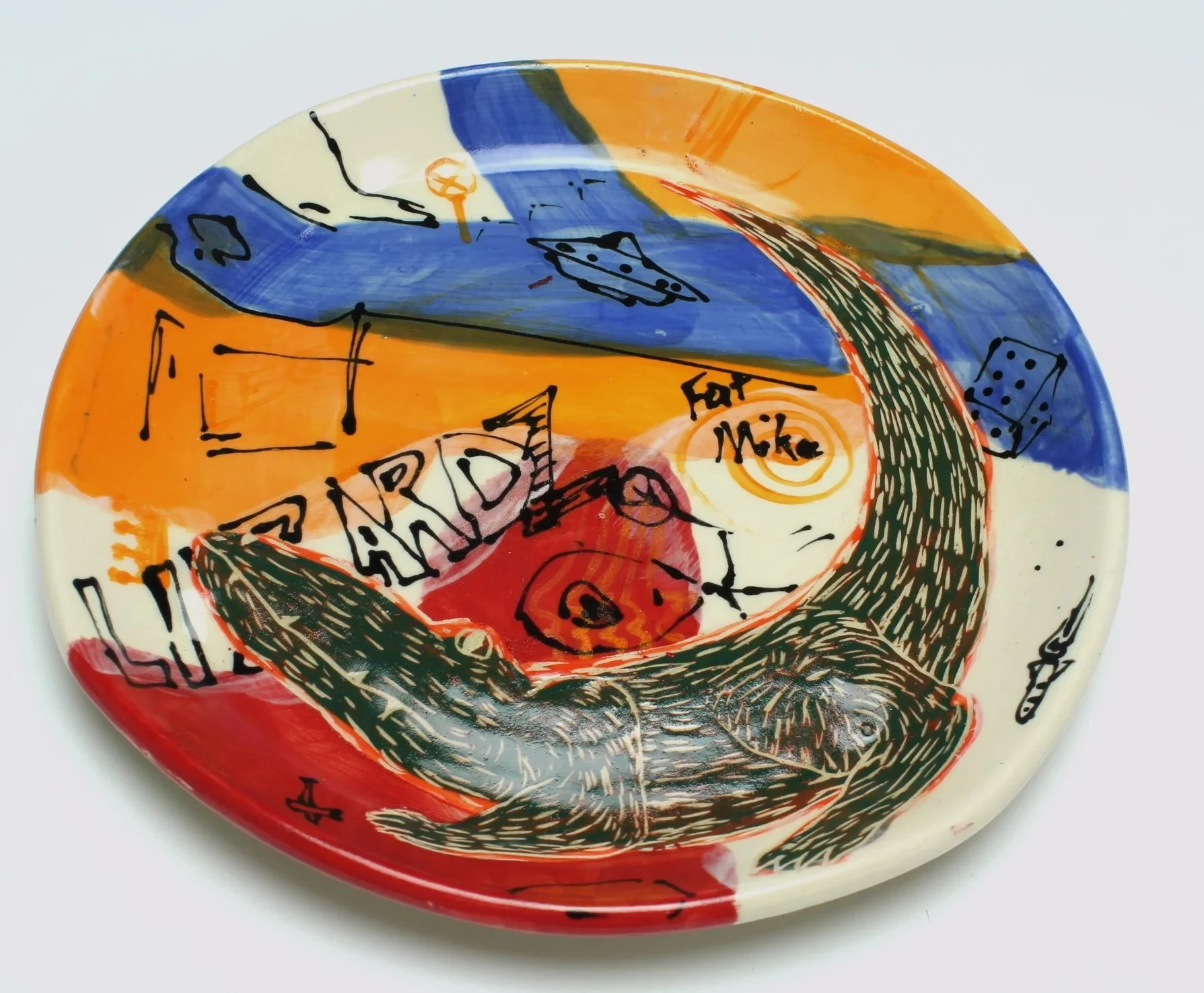
I take a lot of commissions, and enjoy making people’s ideas come to life, it often takes me in unexpected directions. It’s an honor to make things that get to be used every day. I was getting a lot of requests for plates before I left Jackson Hole to teach a semester at Interlochen in Michigan, so that became a goal for me while I was there. When I returned home, I was more comfortable making plates and happened to meet a chef who was looking for handmade dishes to use at a pop-up restaurant in Jackson. Word of mouth in the chef community brought me to the White Buffalo Club and the Rusty Parrot where I made custom dishes for the restaurants. Now I make dishes for a private chef in Denver. That is something I never could have imagined, it is such a dream and equally terrifying. I learn more about use and design by how chefs see food being plated. This entirely changed my way of thinking about making pottery.
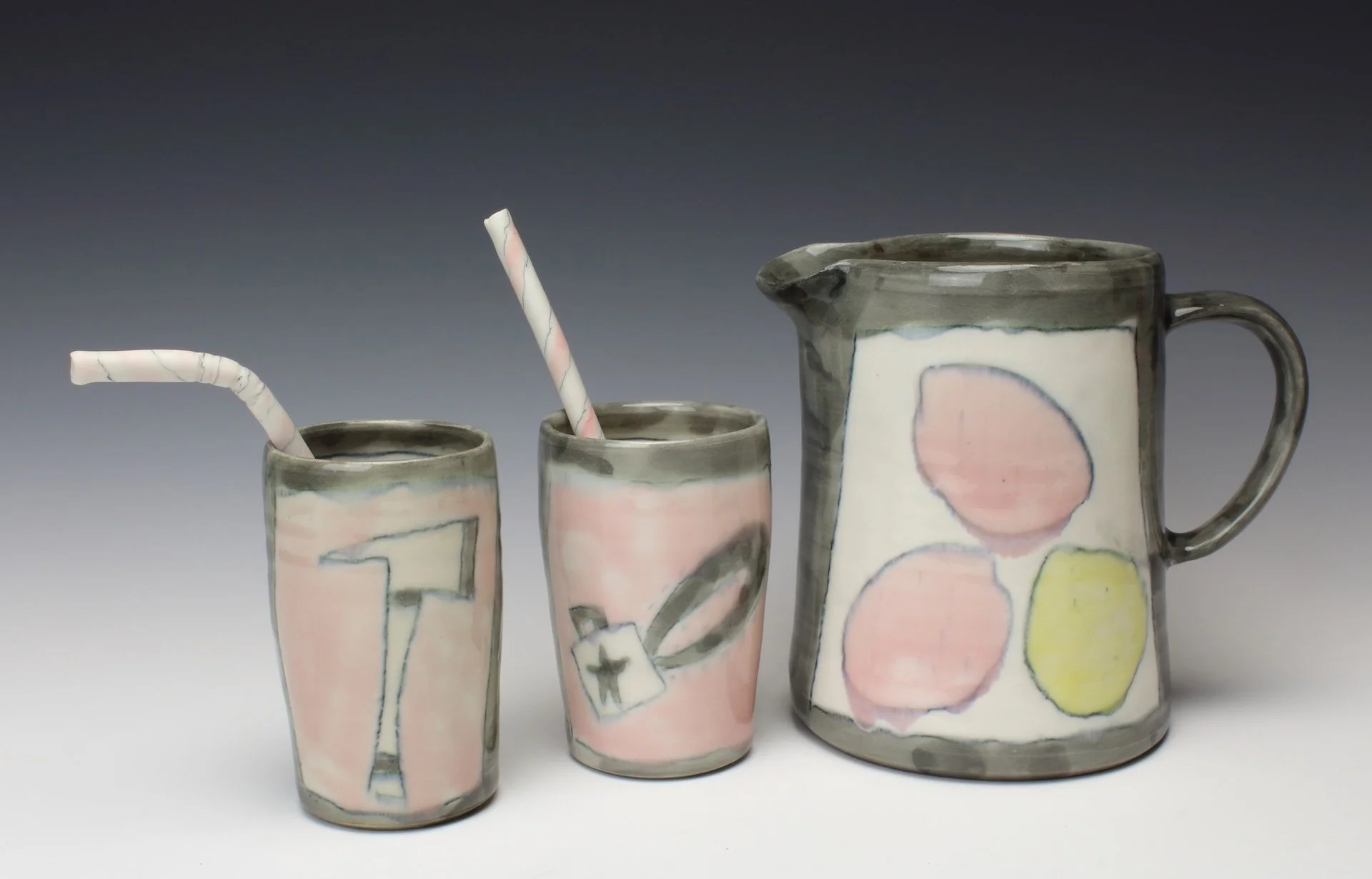
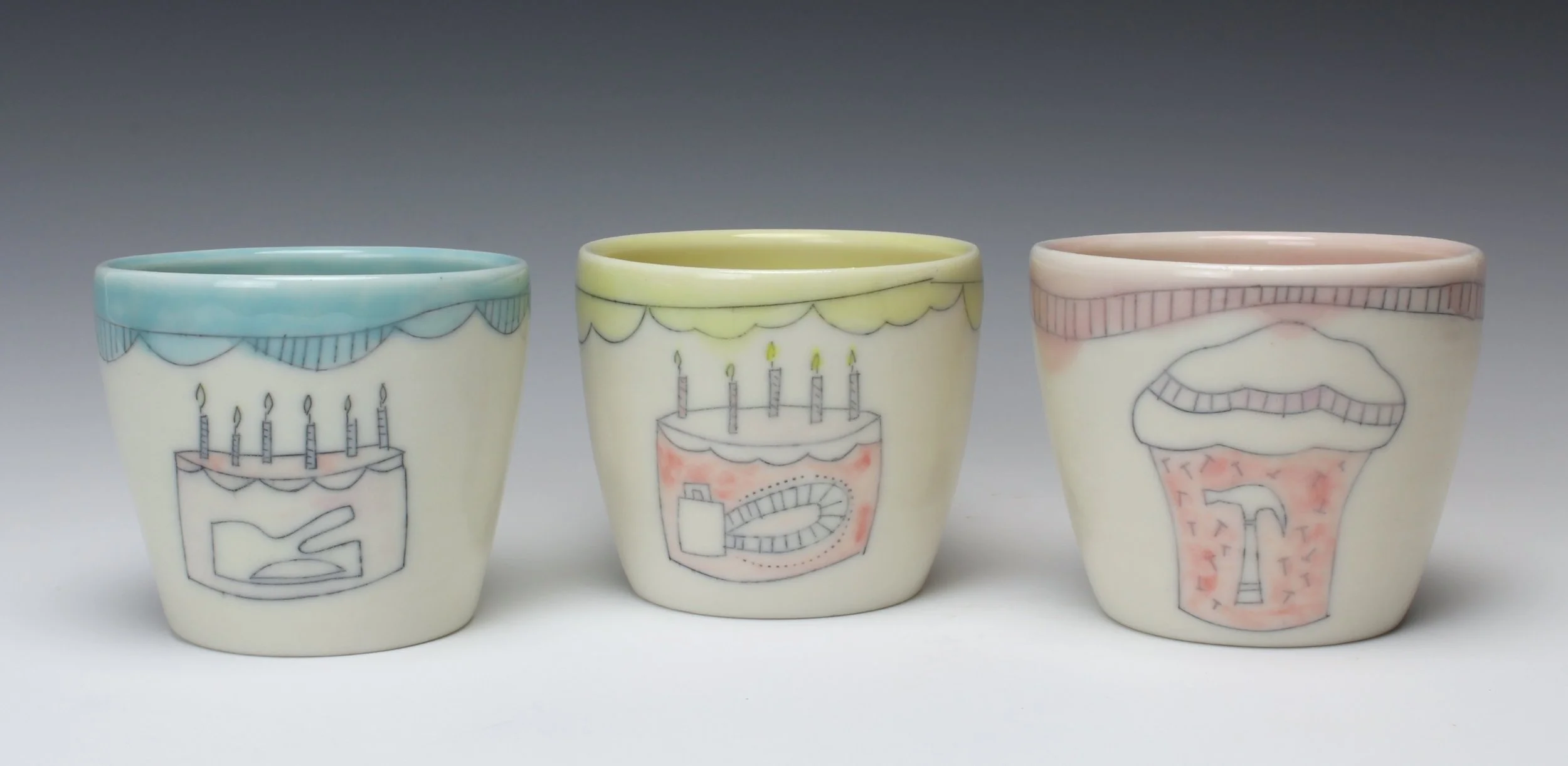
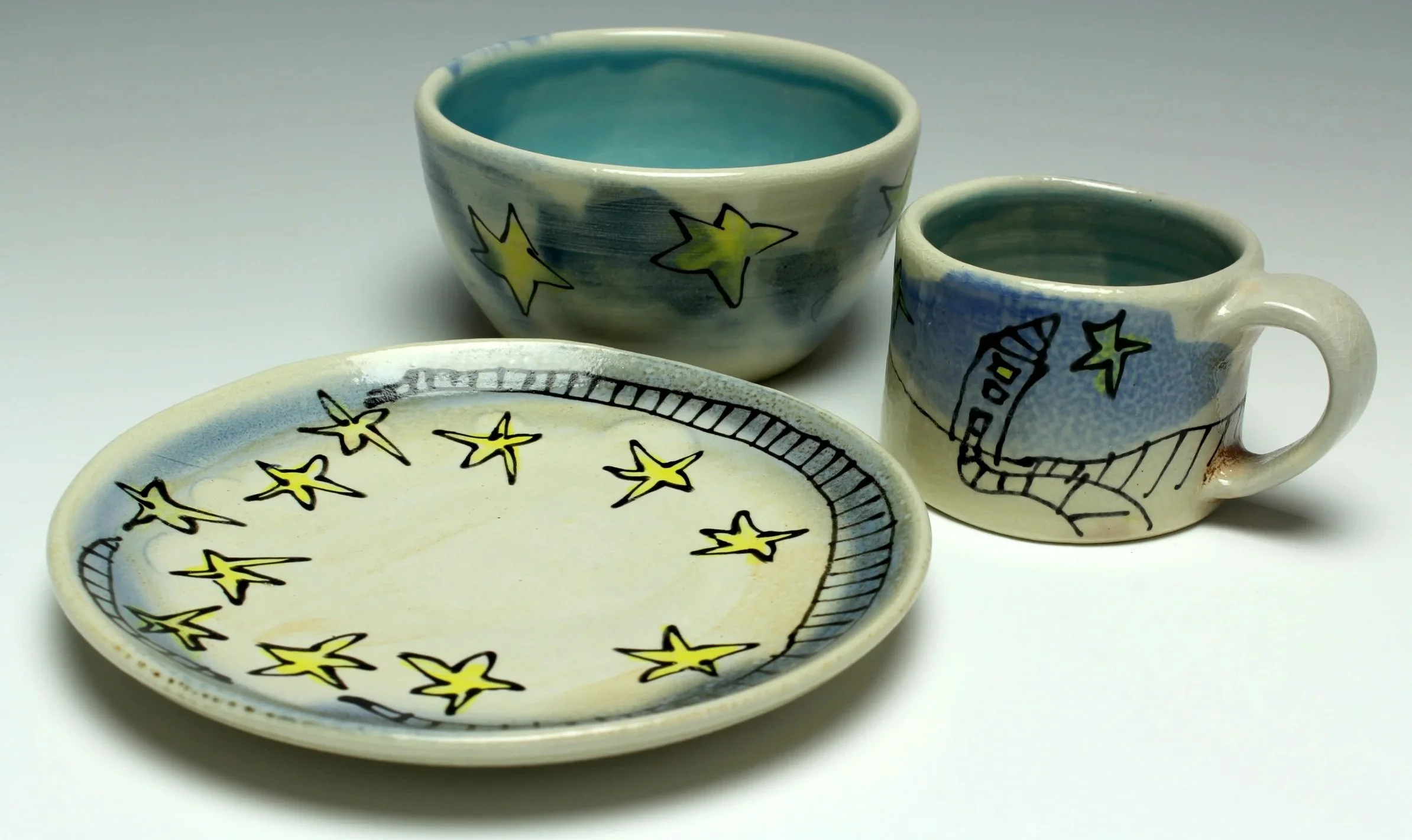
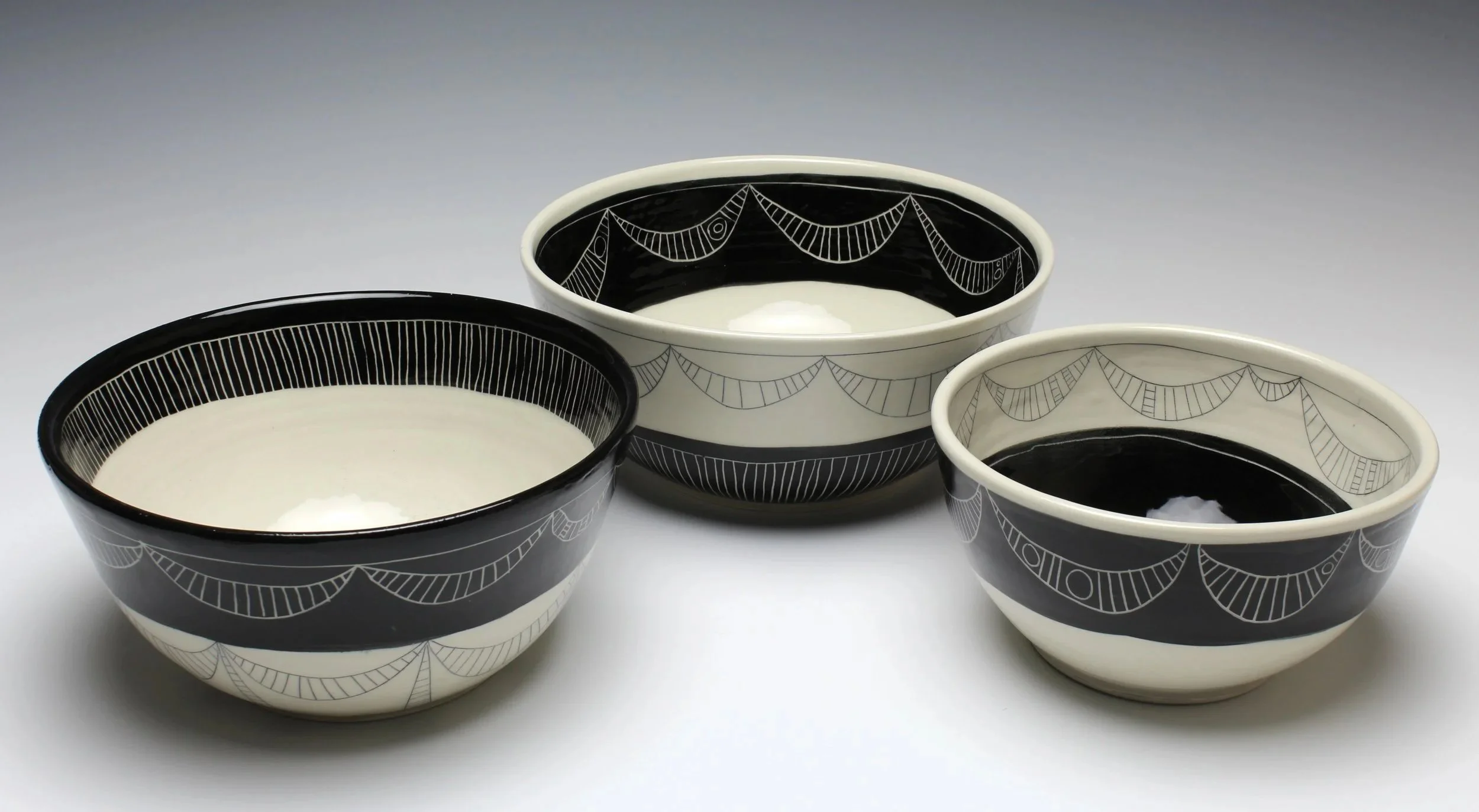
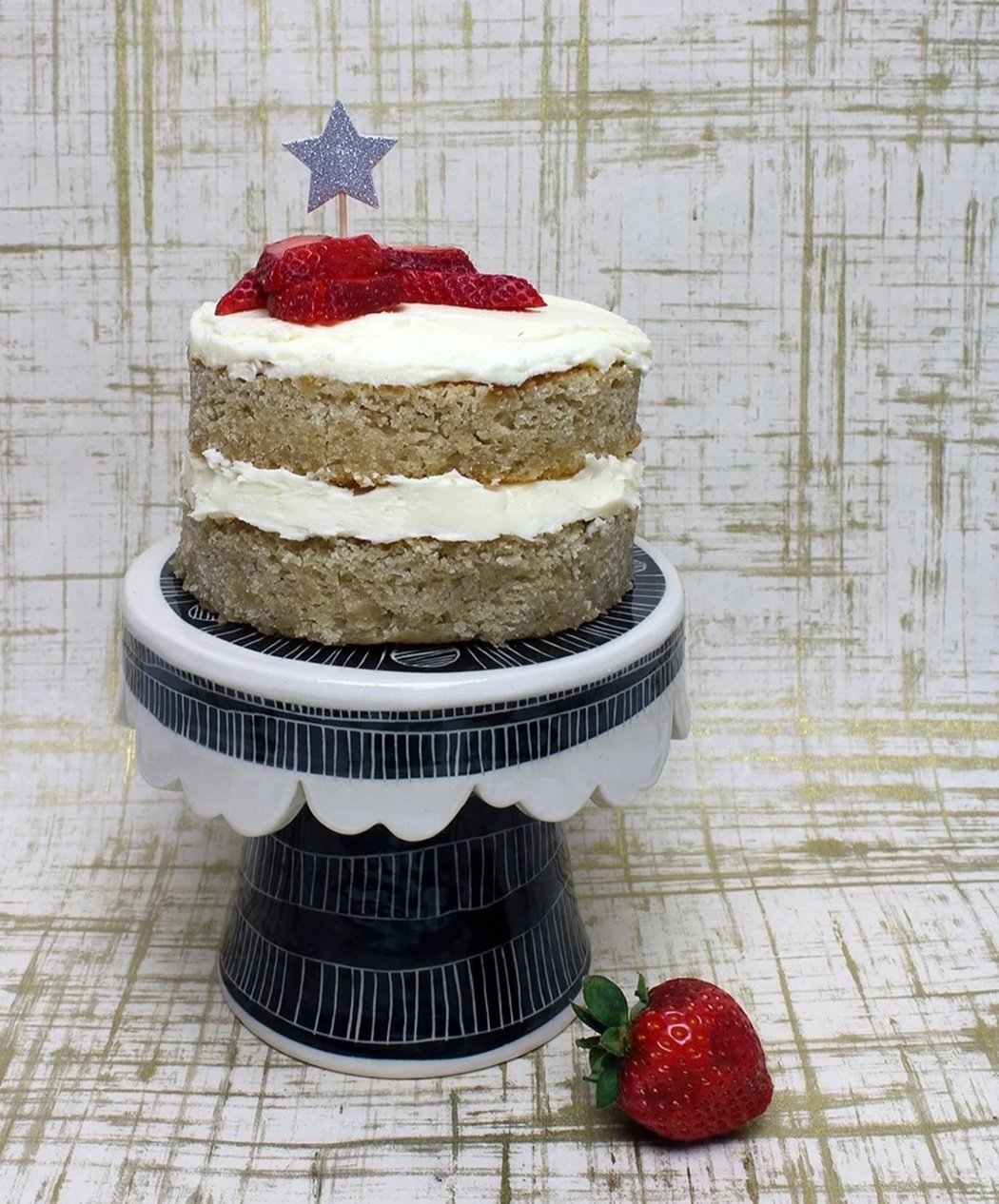
AAS: Sam, I first saw your Bag Cups at the Arkansas Museum of Fine Arts Gift Shop. They are terrific. Do these undergo multiple firings for the different glazes and colors?
Bag Cups, textured slab hand built porcelain, stains, glaze, each: 5” x 4” x 4”
SD: To me these are “Bag” or “Folded” or “Origami” cups. I first saw a finished origami cup while at KSU. It was just a simple cup with a net as texture, iron oxide stain and glazed interior. I can’t remember the visiting artist’s name, but as soon as she cut and held up the template she used to start constructing the cup, I was hooked. Over the years, I’ve revisited this form often and tried to improve on it, adding different layers of texture, texture that I find in nature and in junk stores, texture that our hands love to explore. The cups start off as a slab of clay and then you place a paper origami template over the slab. After folding and joining the sides, I give the cup some gesture by denting or squishing it so it has a looseness to it, like its moving or dancing. Glazing consists of using a stain on the outside of the vessel and a complementary glaze on the inside and the rim. To show off the stain, I like to use porcelain clay although I occasionally use brown stoneware, you just don’t get vibrant color with that clay though. I always stuck to hand sized cups, but when we started selling them at the Arkansas Museum of Fine Arts Gift Shop, Leon asked me about making a utensil sized version, which I now include in our repertoire along with larger plant pots.
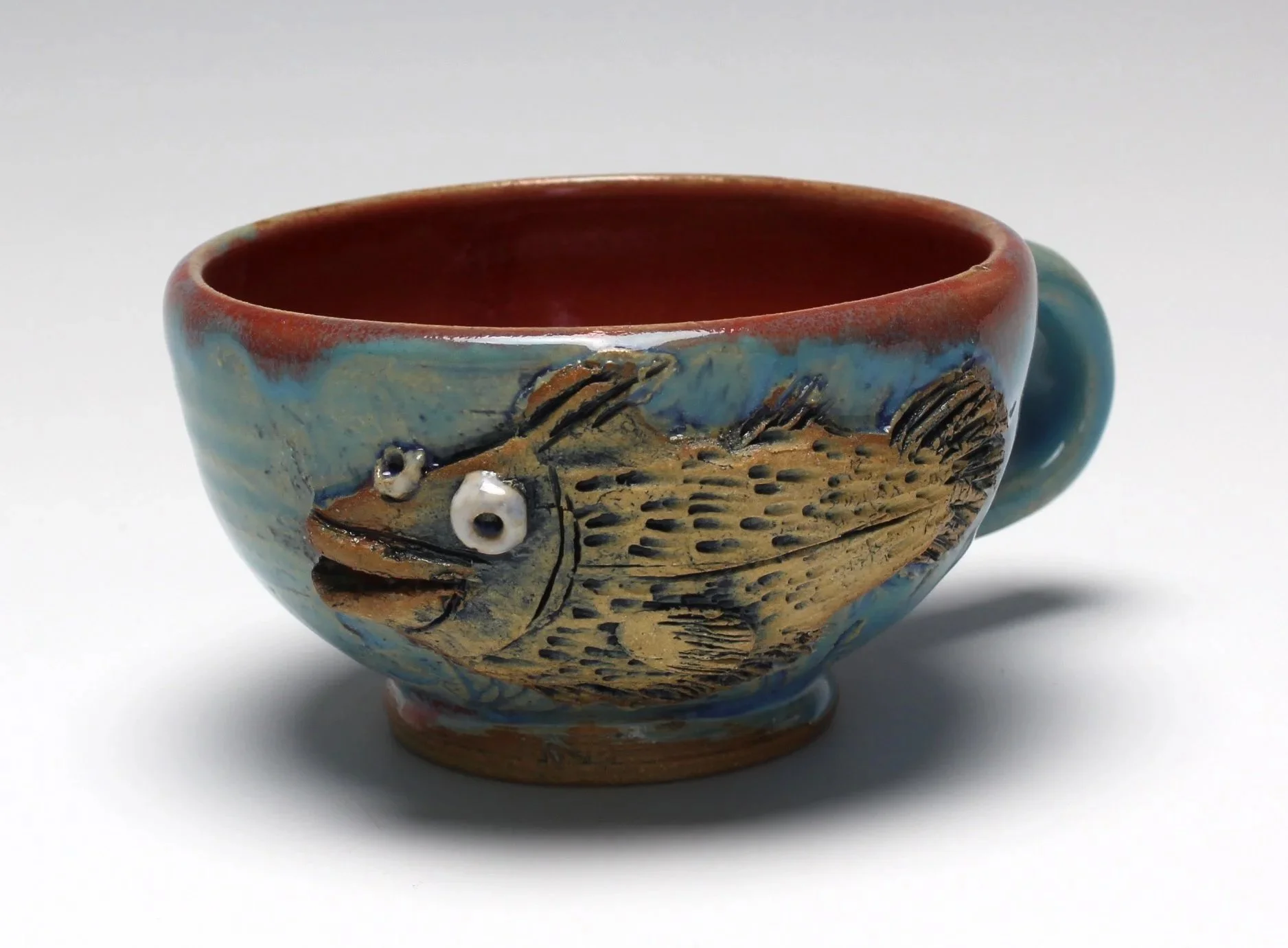
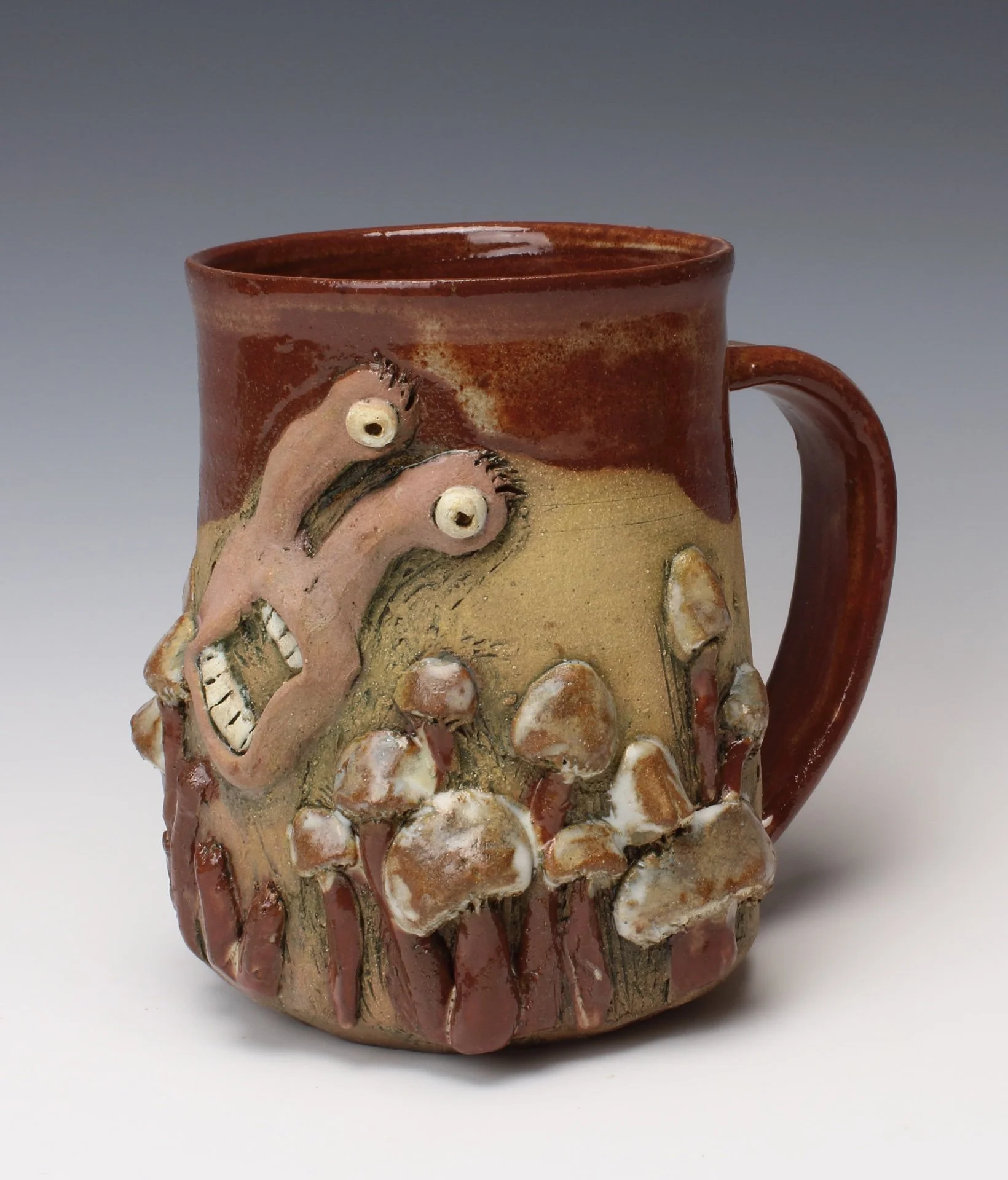
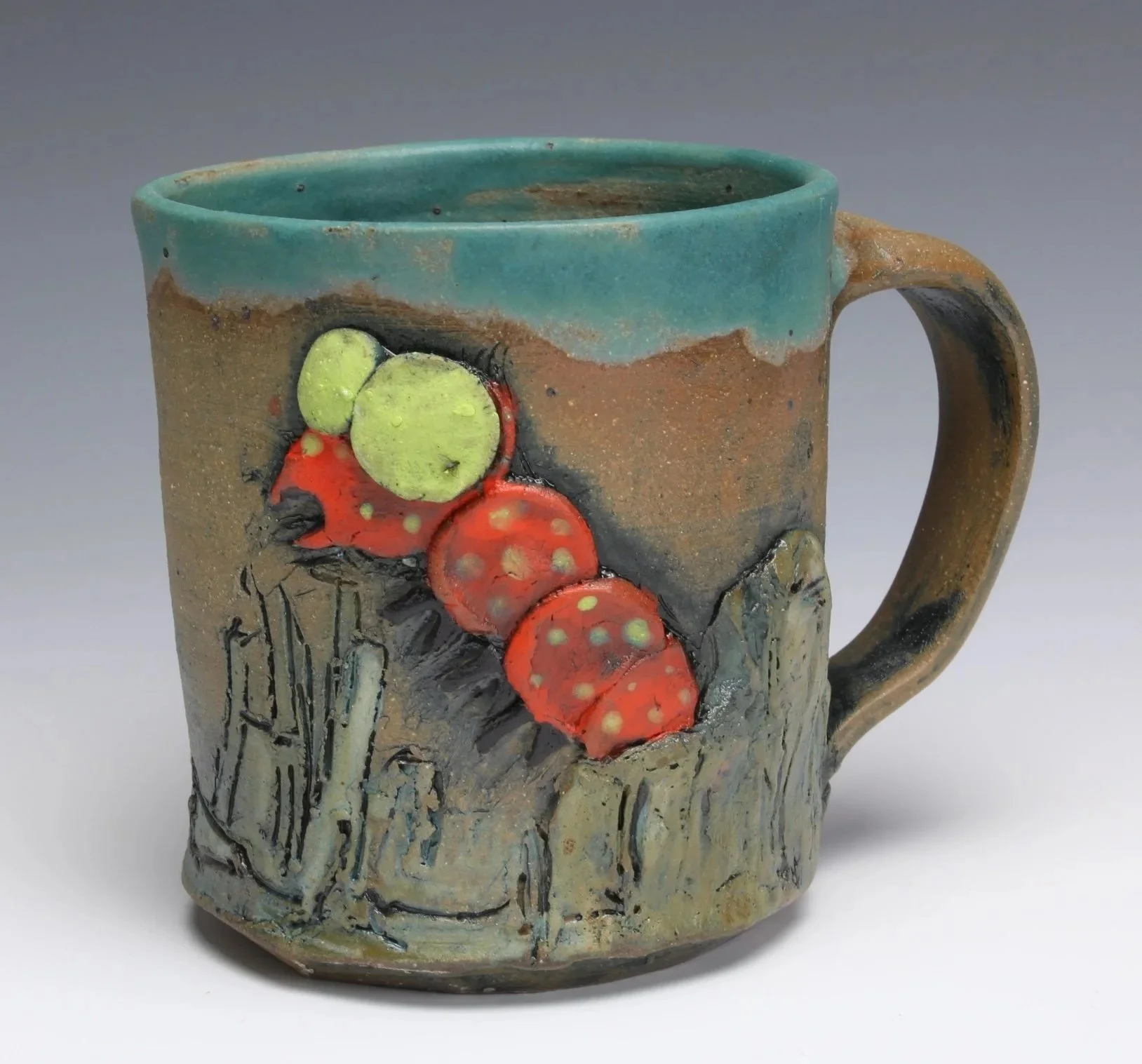
AAS: Owl Mug is another of your surprise textural and sculptural vessels from your Animals Series. Tell me about it and that series.
Owl Mug, stoneware, stains, glaze, 5” x 4” x 5”
SD: This line of work sprouted from when I went to a few artist workshops at the Archie Bray in Helena, Montana while I lived in Wyoming. I was most impressed by the workshop with Ron Meyers and that started my exploration of applying sculptural imagery to mugs. You basically apply clay with a method called sprigging to the leather hard vessel and start sculpting. My subjects derive and are inspired from subjects that include The Far Side comic strip, watching campy monster movies, our planet’s animal kingdom and sci-fi tropes. I like to sculpt these using low, middle and high relief, sometimes going a bit overboard. Care needs to be taken by the mug owner to not break beaks and horns off!
AAS: Then there are your Veggie Mugs from your Veggies Series. I just love them.
Veggie Mugs, slipcast and altered porcelain, stains, glaze, each approximately: 5” x 4” x 5”
SD: This series began, funnily enough, at the grocery store, just having picked up an artichoke and asking Jenny if she’d use a cup shaped like this. I also remember my parents having a plate setting that had embossed grape leaves and grapes on them so I thought it would be funnily to bring some more funky kitsch into my repertoire. After slip casting several veggies, I wondered how they should sit on the table and came to like the vine-like feet. I like how the pots look like they can walk away when you’re not looking. Recently I started to combine the cast veggies with the techniques of the “Bag” cups by adding a textured slab to the cast piece and a handle that contrasts between organic and “man-made”. Glazing emphasizes this effect, stains bring out textures, and glaze and underglaze decorate or highlight interesting areas.
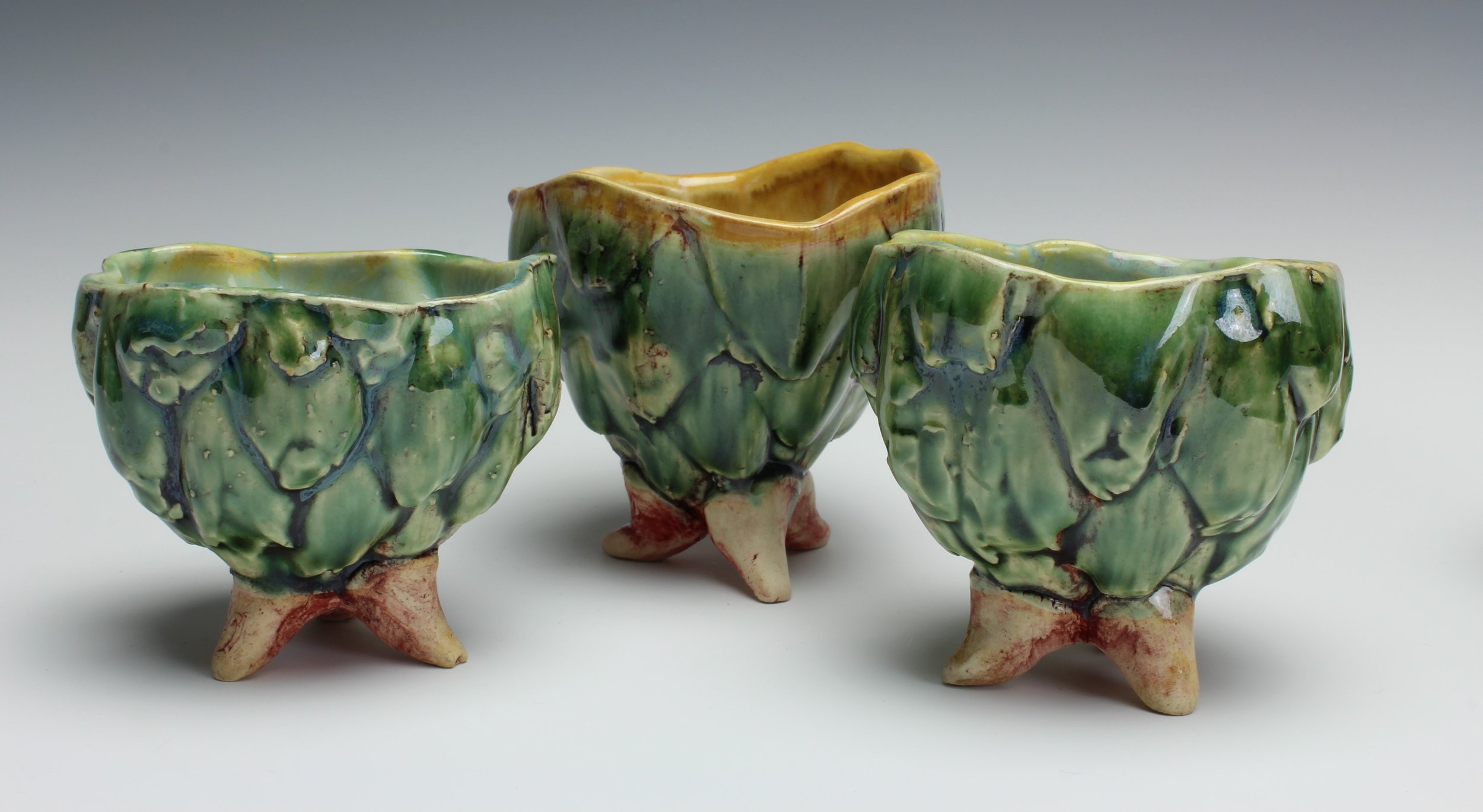
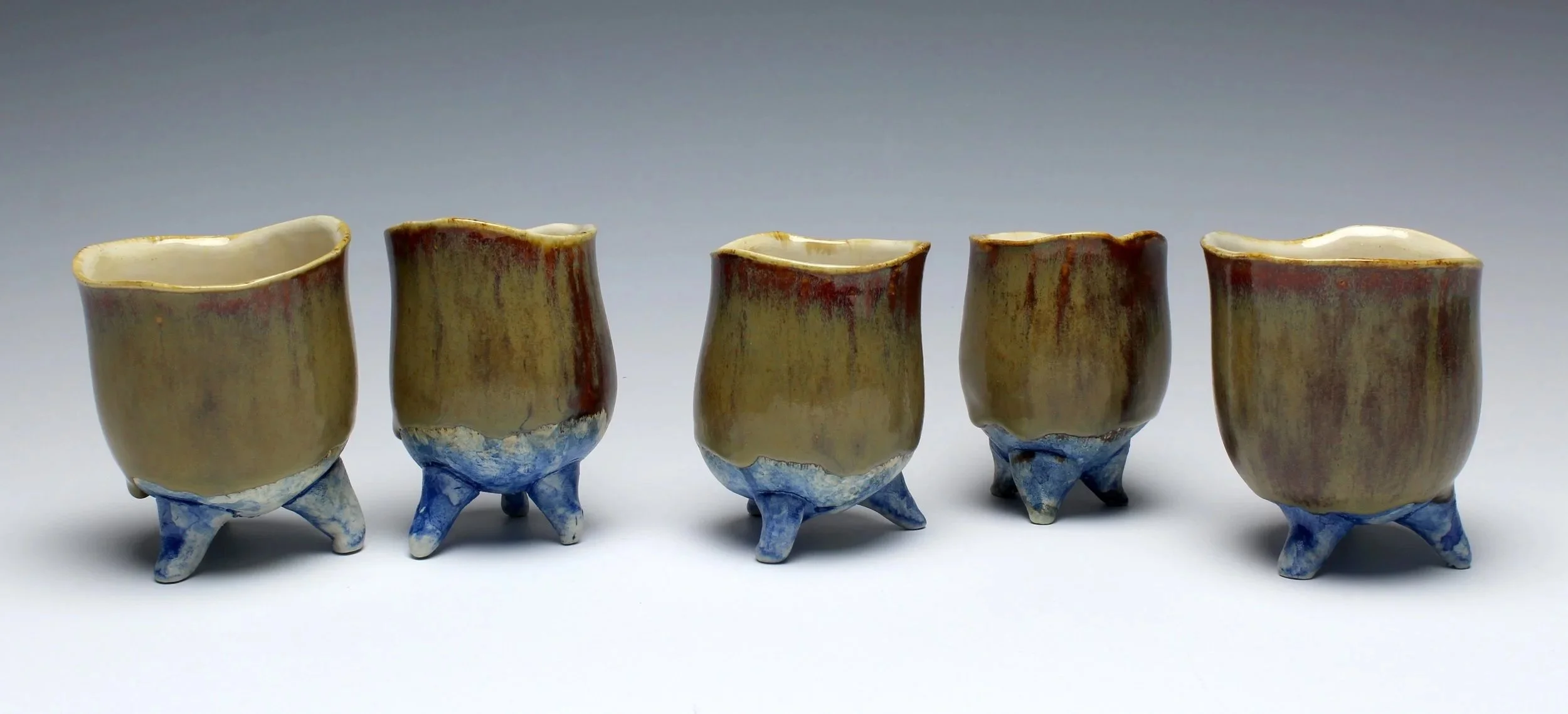
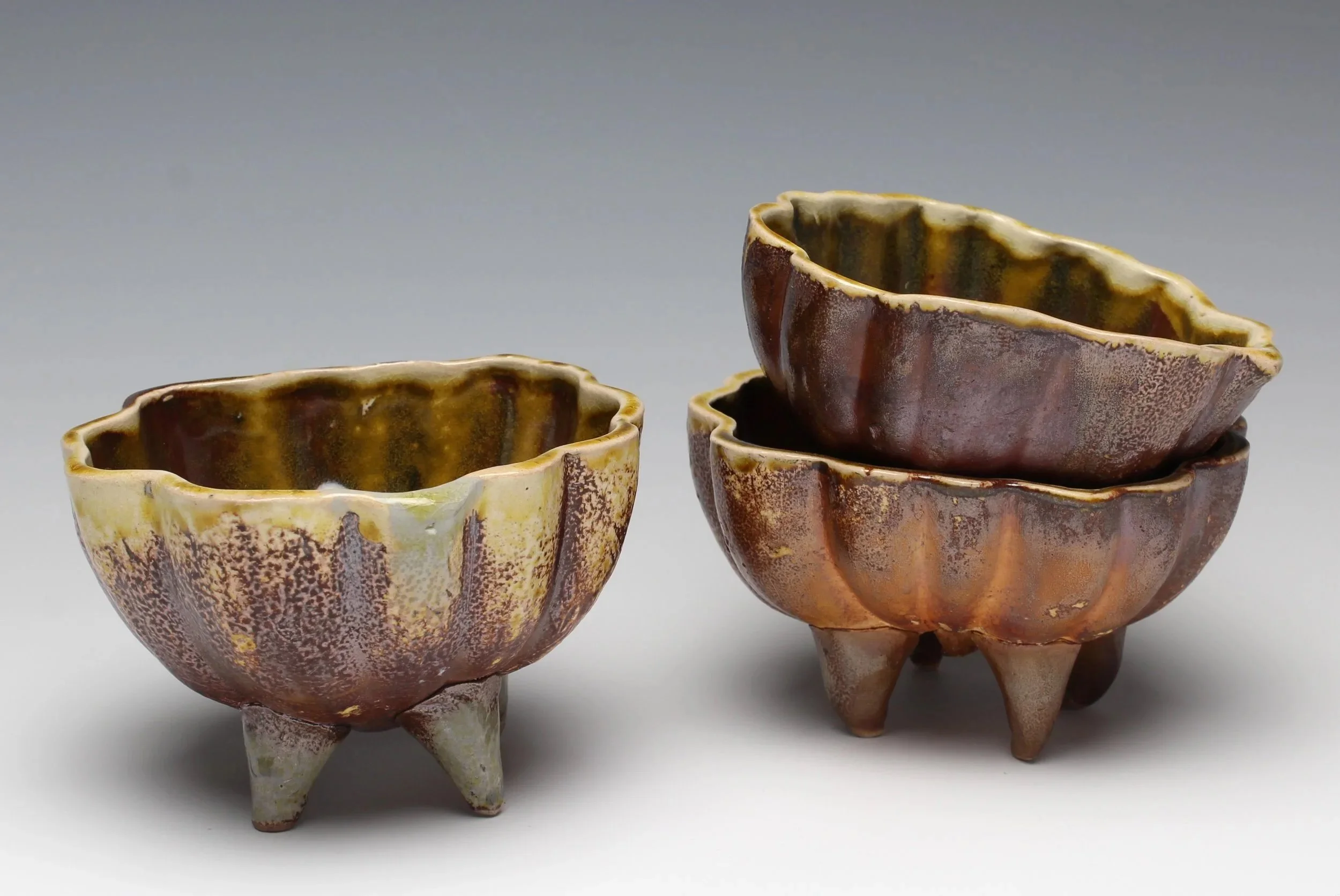
AAS: Guys, I mean, what could be better than having something FUN to eat or drink out of! That seems to be your philosophy as potters.
SD: I would like everyone to have some sort of aesthetic experience from using our pots. I do enjoy the excitement in peoples’ eyes as they explore our wares and talking to our fans at art markets and having them tell us stories about how their roommate started to use their cup and now they needed another one to keep for themselves.
JD: I’ve always loved to cook, and I like being inspired by the dish when cooking but also inspired by the food when making pottery. We get reports about our pottery out in the wild, how that favorite mug is in constant use and never goes back in the cupboard. Our cupboards are full of pottery, some made by us, some by friends, plus potters from all over. It’s like saying hello every time we open a door, and we ask for certain things by the name of the potter if we know it.
AAS: I suspect the summer is a busy time for you. Do you have events/festivals/fairs coming up soon? And what do you do in the “off season”, if there is ever such a thing?
SD: I also do a lot of projects including maintenance projects on both the studio and the house and yard/gardens. For fun I watch movies and build LEGO sets and each summer I trek to Denver and geek out with some college buddies playing board and roleplaying games and every two years I go white water rafting with my old neighbors in Wyoming.
JD: Winter and the early months of the year seem to be the biggest production times, working to refill the inventory and get shops restocked for spring. Right now, we are at the Farmington Farmers Market once a month, and our next big event is the AMFA Art Market in Little Rock, September 11 – 13. After that we’ll be at the Cane Hill Harvest Festival September 19th, and Homegrown in Siloam Springs on October 3rd. When I’m not in the studio, I’m in the garden taking full advantage of the long growing season. I enjoy the combination of gardening, pottery, and art making, each take their own type of patience and are rewarding. Sam and I also love B-movies and old sci-fi movies. We also watch a lot of cooking shows, partly because we love cooking, but sometimes we get ideas for pottery.