Interview with artist Lily Hollinden
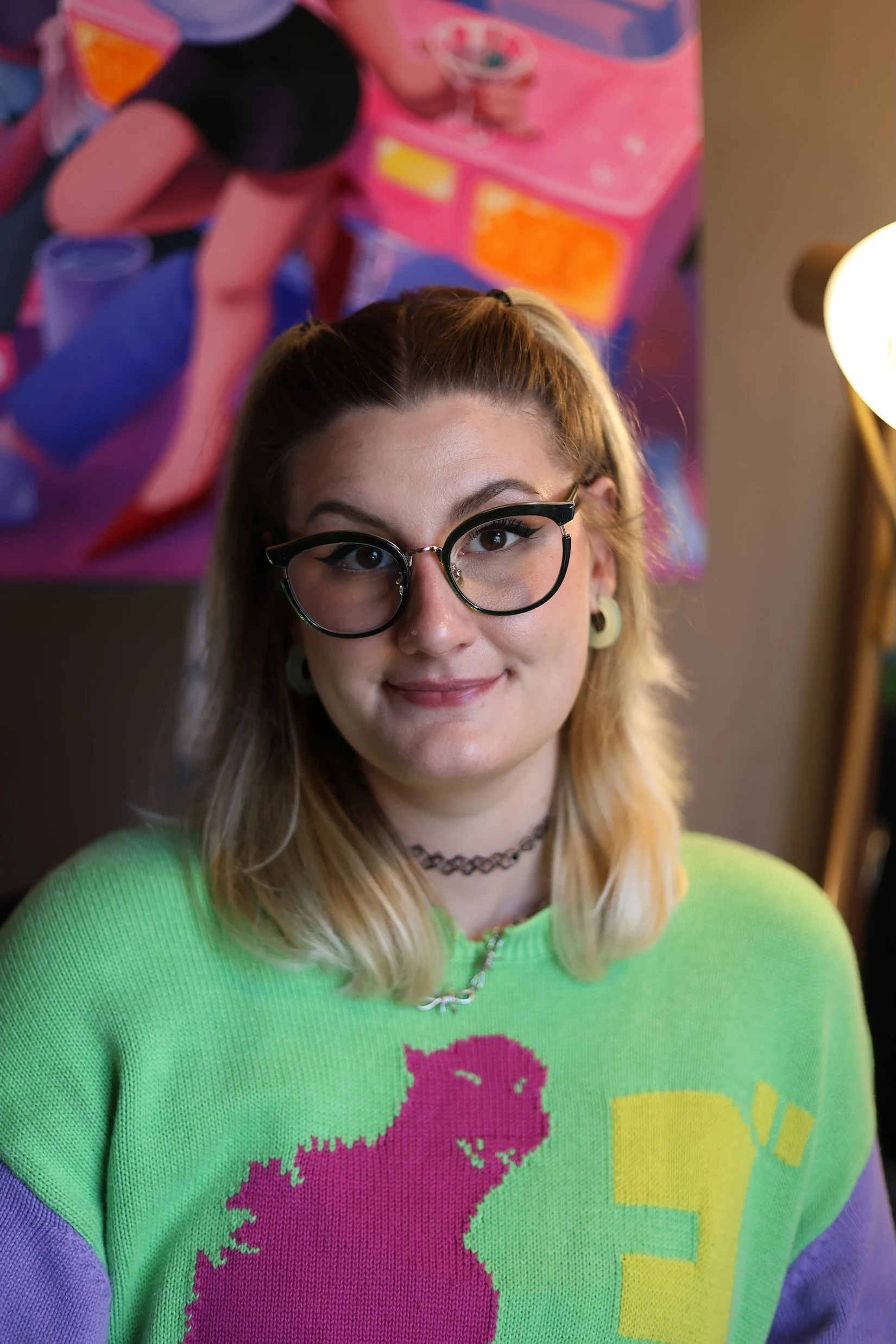
Lily Hollinden is an artist living in Conway, Arkansas. She received her BFA from Indiana University Bloomington in 2019, her MFA at the University of Arkansas Fayetteville in 2024, and is currently Assistant Professor of Art at Hendrix College. Lily uses sarcasm and irony and colorful expansive narratives in her artwork to communicate truths about identity and sense of (her) self. More of Lily’s work can be found at MIXD Gallery in Rogers, Arkansas and at lilyhollinden.com.
AAS: Lily, are you an Arkansas native?
LH: I am not, actually! I lived in Bloomington, Indiana, for the vast majority of my life. I got my BFA at Indiana University, where my dad taught music history. I originally moved to Arkansas in 2021 to get my MFA at the University of Arkansas in Fayetteville. I’ve been in Arkansas for about five years now, and I currently live in Conway and teach at Hendrix College.
AAS: Congratulations on your recent MFA! That is a significant achievement. What do you feel are some the most important things you learned or discovered?
LH: Well, thank you very much! I had a fantastic time in grad school, and my MFA is definitely my biggest achievement, so far. My time at UA taught me so many things, particularly how to find the connections between my personal practice and the broader art world and history of painting. I had some really fantastic faculty that encouraged me to be weird and wild with my pieces. I’ll always remember one critique during my second year where one of the painting professors said to me, “Lily, if you’re thinking about painting like it’s a job, I want you to do a painting that would get you fired.” That phrasing has stuck in my head ever since. Grad school really taught me how to examine myself and gave me the courage to make the funny and playful artworks that I do. There’s always a reason to be found to make even the most ridiculous art, you just need to find the reason. In a lot of ways, the most important things I learned in grad school were about myself; what matters to me in an artwork, how I connect with the world around me, and how to express a complex interior philosophy.
“There’s always a reason to be found to make even the most ridiculous art, you just need to find the reason.”
AAS: Did you have any artist role models growing up?
LH: I’d say the biggest artist role models I had were the comic artists who illustrated so many series that I adored. As a young kid, Calvin and Hobbes and Garfield comics were a constant presence, and as I got a little older, I got hugely into manga series like Zatch Bell and Death Note. I was very much a dork for action and fantasy, and I wanted to go into comic book illustration. I consider that kind of work to be my first love, and I still enjoy designing cool characters and fantastical creatures when I have the free time for it. It wasn’t until I got to college that I started becoming very interested in the fine art world, and I became enamored with oil painting during my freshman year. These two artistic worlds make up both hemispheres of my creative identity.
AAS: Tell me about a recurrent character in your recent painting, Pepper Plinkett.
Floor Spaghetti, 32” x 40”, oil on canvas
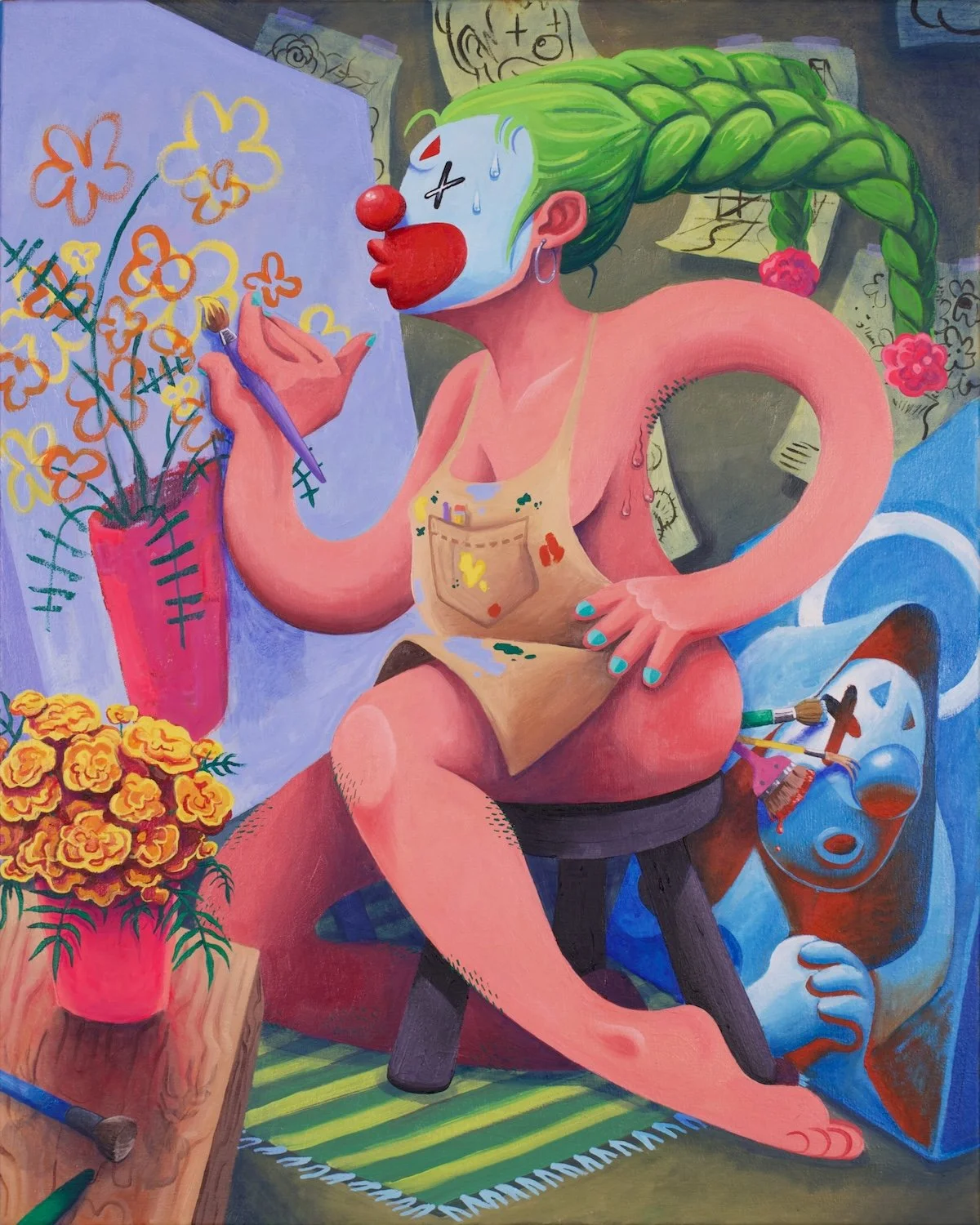
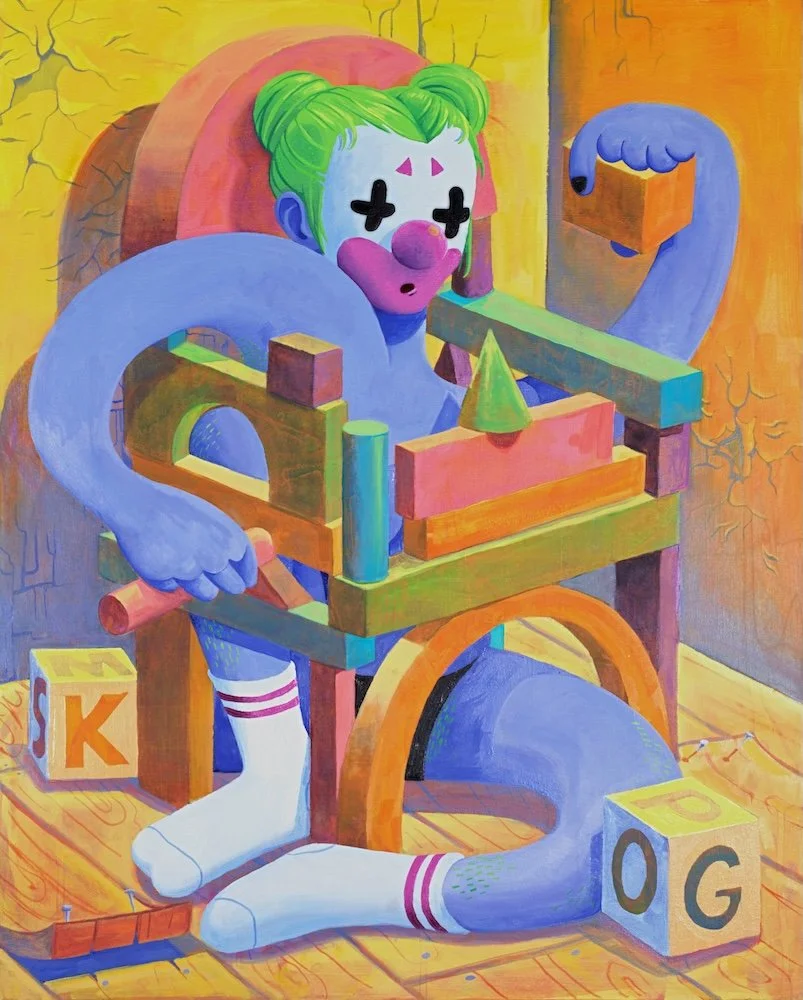
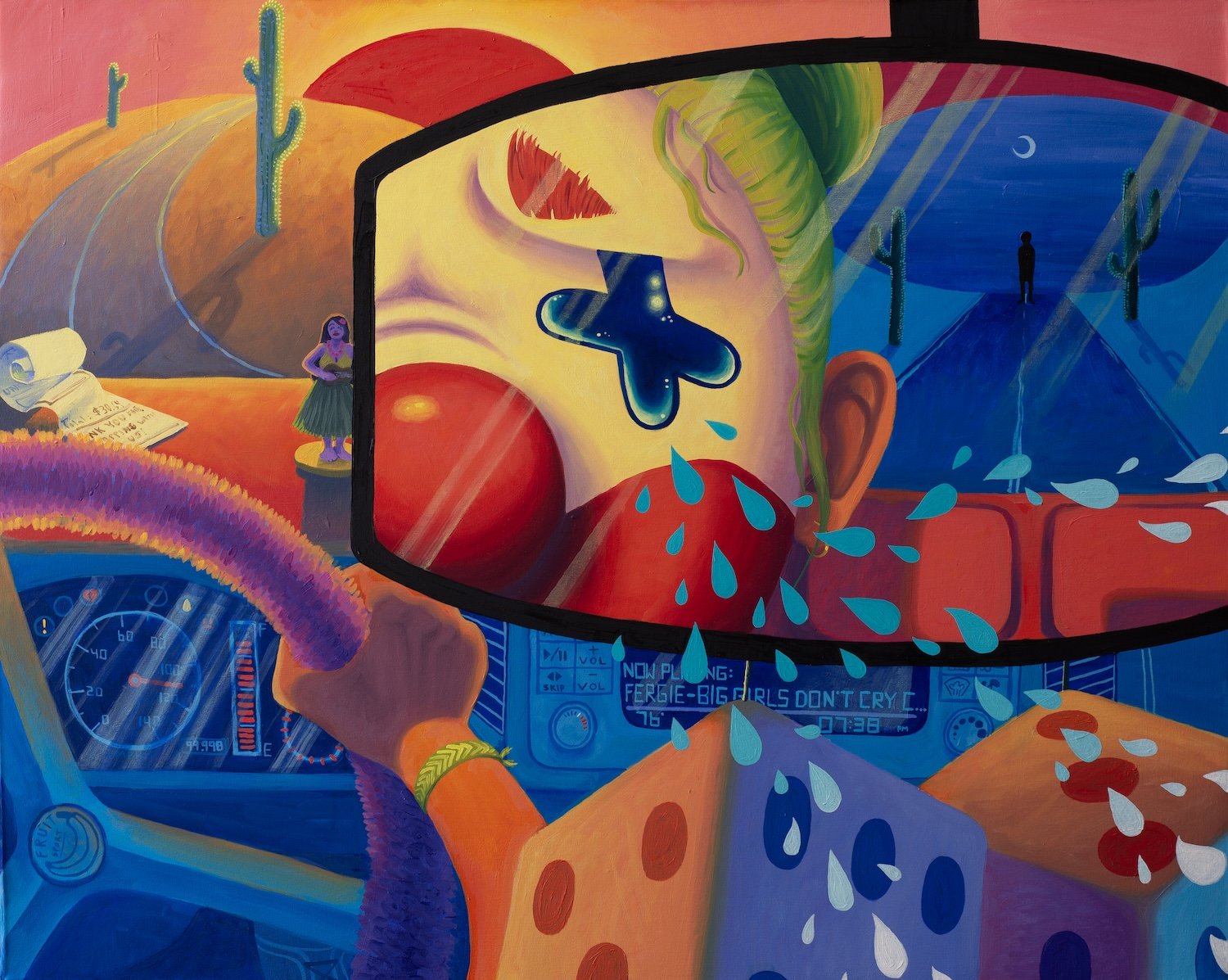
LH: Ah, Pepper, my muse! Pepper is, in essence, my alter-ego character. I used to feature myself in many of my paintings, but I found that, over time, I felt like I only had the room to paint about things that I had very direct personal experience with. I had begun painting clowns in the fall of 2022, a subject matter that felt almost too ridiculous to make serious artworks about, in the spirit of “getting myself fired” from painting. In early 2023, I painted Floor Spaghetti, featuring myself in clown makeup which ended up being the basis, design wise, for Pepper. Using a stand-in for myself allowed me to expand my conceptual framework into a wider, less literal and more philosophical environment. She is representative of the sad clown paradox, a cliché that I deeply relate to. I can use Pepper a lot like a doll, or avatar, to experience and express things that I, Lily, cannot.
Memento Sileo, 48” x 36”, acrylic and oil on canvas
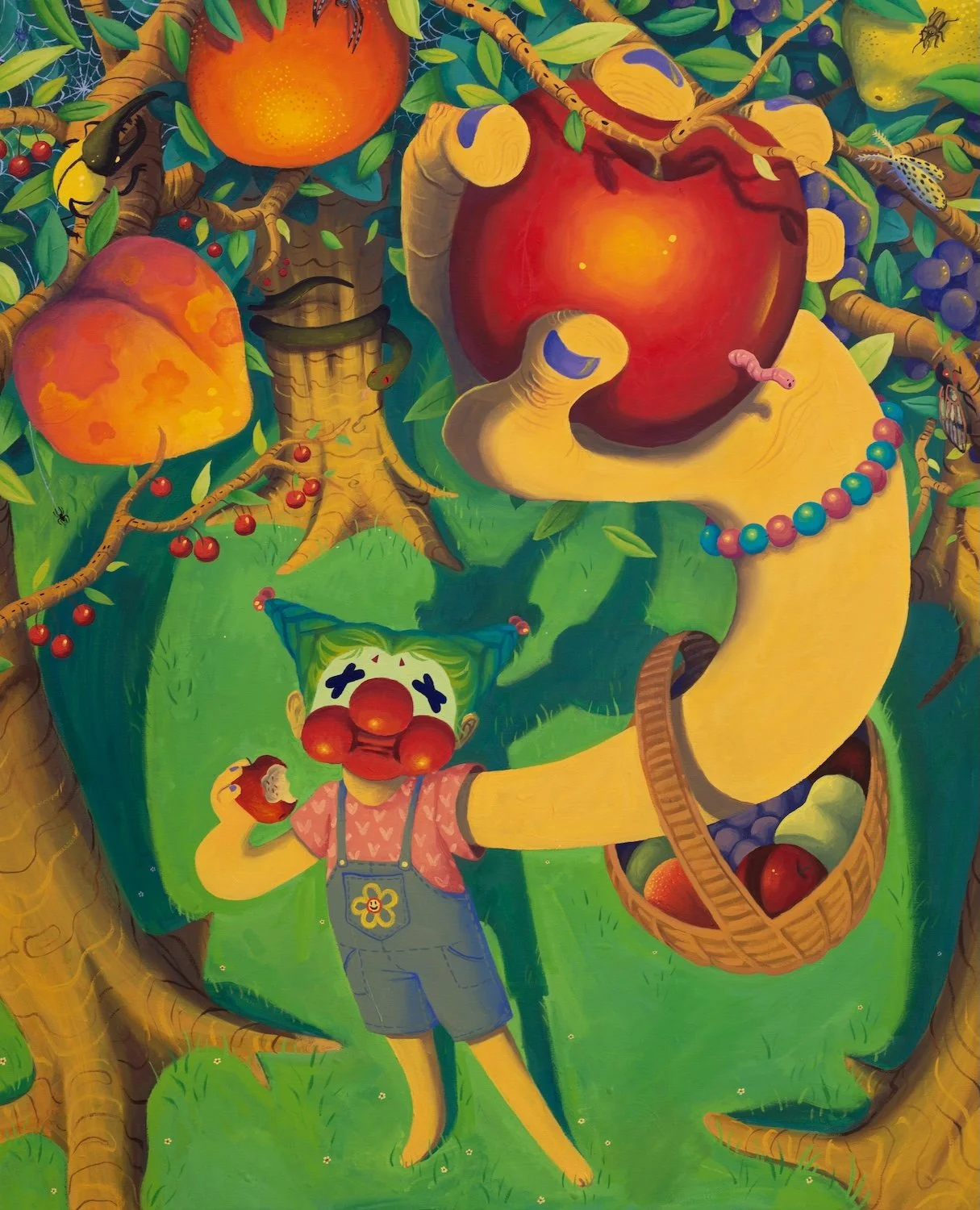
Pepper was the basis for my entire MFA thesis, and that body of work illustrated a narrative of her life — growing up, experiencing love and adventure, heartbreak and conflict, and ending with her demise (and rebirth) in the final painting, Memento Sileo. In my mind, she is kind of a timeless, observant, playful, and curious being. Not really a human, but almost like if clowns were an alien sister-species of humans.
AAS: Pepper does have many personalities. One of my favorites is Girlboss Garage. All of your paintings are very colorful, but in this one I feel like I am viewing it through rose-colored glasses.
Girlboss Garage, 30” x 24”, oil on canvas
LH: I am amused by the term “girlboss”; it’s a funny, pseudo-feminist term. In Girlboss Garage, I wanted to depict this kind of sexy corporate business bitch (for lack of a better term). Like so many of my paintings, this one is very much a caricature of capitalistic success through a lens of feminism. Pepper really owns that space, she’s obviously in the way of the workers fixing and cleaning her car, but she’s the Girlboss, so she takes her very important phone call and sips an olive martini in the middle of the mechanic’s garage. The pink and purple color palette amps up this veneer of meaningless femininity. This painting pokes fun at Barbie-feminism — the idea that being a capitalist big-shot in a short skirt and heels somehow equals empowerment.
AAS: I want to ask about Then, Now, Later. The title suggests it is perhaps autobiographical. Tell me about it.
Then, Now, Later, 72’” x 48”, oil on canvas
LH: I’m glad you asked about this painting, because it’s one of my personal favorites! Then, Now, Later is about my own personal and artistic evolution. It features three figures all balanced on top of one another. The cat-lady figure on the bottom is actually a little character I invented when I was around 10 or 11, another kind of alter-ego from back when I was really into manga. She represents how I used to be and the art I used to make. In the middle, we have Pepper as we know her, propped up by this earlier iteration. And lastly, we have Pepper as a mermaid. Mermaids have made a few appearances in my work over the last few years, and they symbolize the future, as well as the completion of a cycle. The idea around this comes from the evolution of aquatic mammals like whales and porpoises. They started as fish in the ocean, as we all did, then they evolved to become mammals on land, then they evolved even further and went back into the ocean. I like to think that humans could do the same. In this painting, I’m thinking about these different versions of myself, and how we build off our past selves as we grow. These three phases all exist as one in this work, surrounded by an audience with mixed reactions to this evolution. Some throw flowers, some throw tomatoes, and some throw hot dogs. I suppose not everyone will like where you came from or where you go!
AAS: You also create ceramics to tell your stories. I just love Worm Rodeo. Was ceramics something you always did?
Worm Rodeo, 5” x 13”, acrylic and resin on stoneware
LH: I’ve dabbled in ceramics off and on for my whole life. I remember going to art camps as a little kid and building pinch pots and little sculptures with clay. I think painting and ceramics are actually very similar; both are involve squishing mud around in some sort of way. I love the physical directness of both mediums. I was able to build a few of these ceramic sculptures for my MFA thesis, and Worm Rodeo is my favorite of these. My parents have a little wooden Loch Ness Monster sculpture that looked like it was “swimming” through a tabletop because of the way it was segmented, and I was really enamored with that optical illusion as a kid, so I stole that structure for this sculpture. I am also a huge Dune fan, so the worm-riding idea was one of the several little Dune references I snuck (and continue to sneak!) into my work. I wanted my ceramic sculptures to feel like they could have just walked out of my paintings, which is why I painted them with acrylic instead of glazes – they ended up with very similar surface qualities. My sculpture work is a fun way to break out of the flat rectangle of a canvas from time to time.
AAS: Your technique with oil is wonderful. I think Fool’s Errand is a good example of the way you show light, shadow and depth. It is an epic painting, but I am curious why you chose to create a story around that classic idiom with your characters.
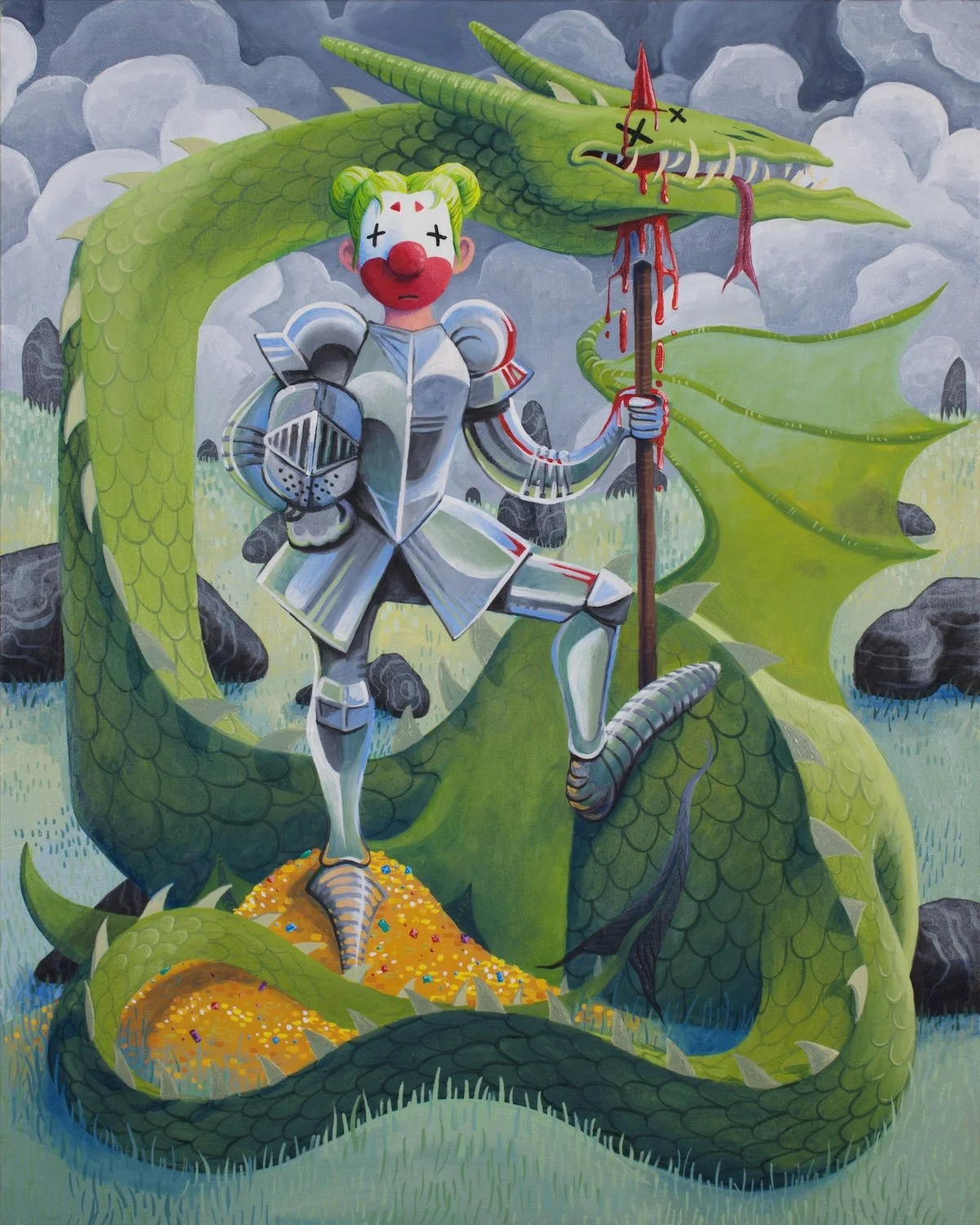
LH: Why, thank you! This painting was meant to serve as the climax to Pepper’s narrative in my thesis exhibition. I knew I needed to have some sort of conflict, and I wanted to make statement about the irrationality and horrors of war. In Fool’s Errand, an army of Pepper-clowns battle with an army lead by a jester, who symbolizes a relationship to power (as though this jester acts for some unseen king, who he aims to entertain). Both sides of this battle use toy weapons of different technological levels, but the death these weapons cause is very real. The fact that fake death machines are given to children to play with is quite absurd, in my opinion.
Fool’s Errand, 48” x 72”, oil on canvas,
In making this work, I also wanted to reference some other famous war paintings from history, particularly Jacques-Louis David’s Napoleon Crossing the Alps and Picasso’s Guernica. These two paintings are such different lenses through which we can view war; the first being an idealized hero leading his valiant army, and the second being an expression of terror and mutilation. Not all of my paintings have a “moral” to them, but Fool’s Errand absolutely does.
AAS: Sorry for the Mess is one of your earlier paintings I find fascinating. I love the honesty and glimpses of what might be important to the story, but the viewer can’t be sure. When you look back at your earlier work do you see your current style and approach beginning to emerge, or do you think you are a totally different painter now?
Sorry For The Mess, 36” x 36”, oil on canvas
LH: I’m glad you enjoy that one! I feel like it hasn’t aged as well as some of my other works, but that’s just my personal relationship to it. I painted Sorry For The Mess as I was entering a new relationship many years ago, when I used a ton of symbolic aquatic imagery. The flooding in the bedroom is representative of a fear of the unknown and general mental health issues I was dealing with, so this painting was a way to express letting someone new “in” to a space that you’re not particularly proud of. I do consider myself to be a very different painter now (more than anything, I just think I’m a much better painter now!), but there will always be a throughline of my artistic DNA in anything I make. I mostly feel like I have a much better grasp on color today than I did back then. Looking back at this older painting, I can see the beginnings of my language of stylizing figures emerging. Also, I’ve always loved painting butts!
AAS: You’re working on a new series, Homunculus. The paintings are in a smaller format compared to your normally large canvases and they are in acrylic. Tell me about that series and Homunculus X.
Homunculus X (Angel), 9” x 12”, acrylic on canvas
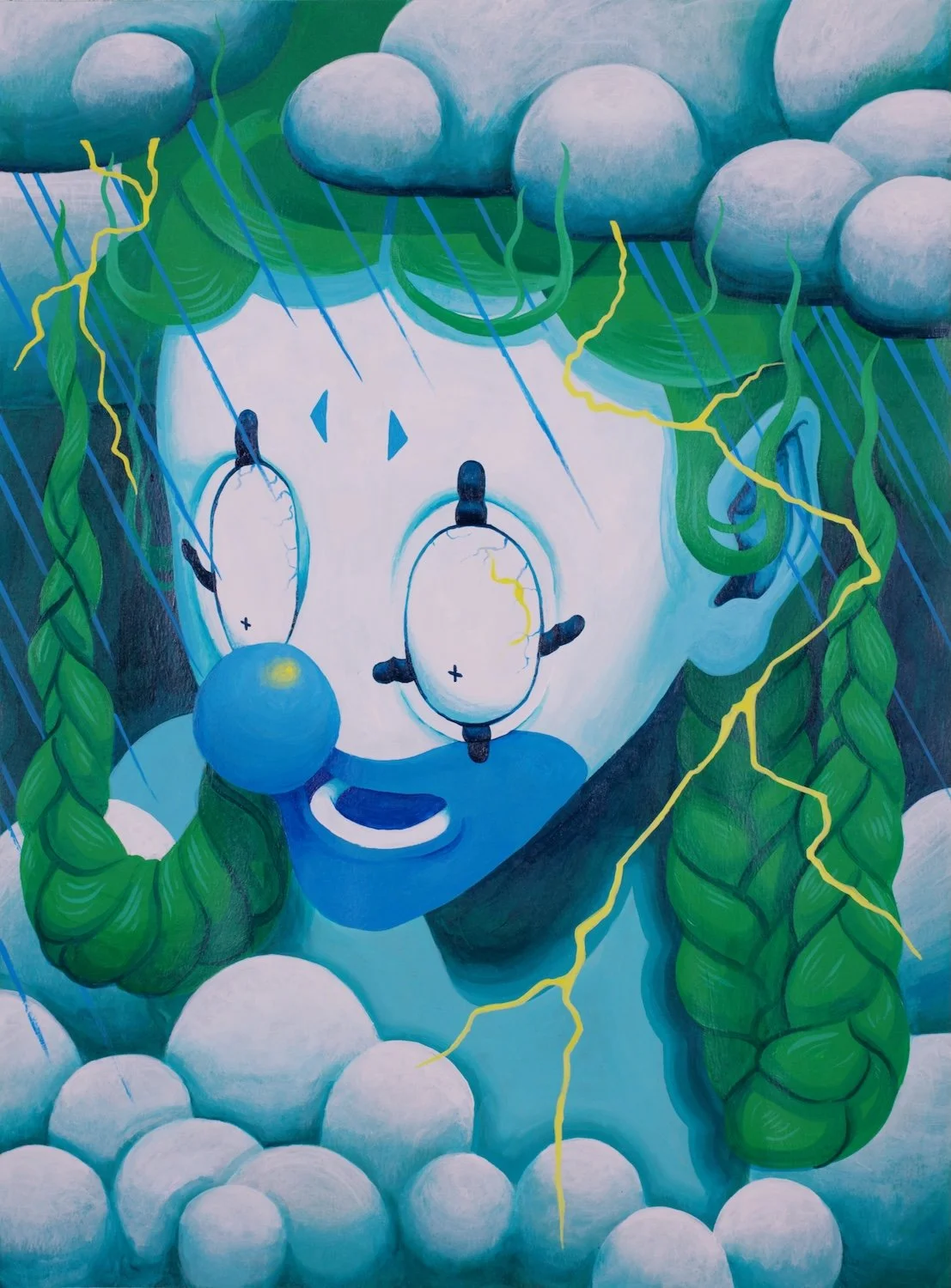
LH: I started making these Homunculus pieces after I finished my MFA to give myself something a bit different from my thesis work to play with. They’re a lot more simple, usually not very compositionally complex, and mostly focus on color and texture. These pieces are a way I consider the relationship between biology and technology. I think most people consider humans to be “extra-natural”, or above the natural, animal world, but I don’t think that’s really the truth of the matter. Humans and our creations are just as much a part of nature as birds and their nests, or beavers and their dams, or bees and their hives. In the history of alchemy, a homunculus is, essentially, an artificially made human, which is a concept I find to be exceedingly interesting. Making my Homunculus paintings, like so much of my work, is a way that I introspect, in this case on my place within humankind and how I don’t always feel completely connected to it. They toe the line between organic and inorganic, native and alien. The painting Homunculus X, which is subtitled Angel, was based off the imagery of a baby pigeon in an egg in a poorly built nest; baby birds look so fetal, I wanted to use one as a subject matter in the series. It’s kind of a symbol of innocence or purity, and a funny thing to compare to a biblical angel, which also holds the connotation of being above nature and humanity. The most exciting part of this painting, to me, is the color palette of golden yellow and periwinkle purple, which has been a complementary combination that has totally overtaken my aesthetic principles.
AAS: Lily, what can we expect from you next?
LH: Hopefully, you’ll see a lot of new paintings! I’m also getting back into making ceramic works, which has been very refreshing. I’ve been focusing a lot on my teaching since I came to Hendrix College, which hasn’t left me a ton of extra studio time, but one of the great things about teaching is that you get regular breaks and a fat summer vacation to hustle in the studio. I also get to do a ton of experimenting and discussing ideas with my students, which helps inspire my work. Now that I teach printmaking classes, I’ve dived into this new media and am very excited by its possibilities. I think teaching keeps me connected to this larger creative, philosophical environment and helps me consider what I find truly important in my artistic practice. I’m still learning to balance the daily rigor of teaching full-time in a very small department, while also giving my studio work the time it deserves. I am extremely grateful that I have an awesome and supportive partner and family who encourage me in all of these creative and professional endeavors. Right now, I’m leaning into my studio being a place for play and investigation instead of a place full of expectations and rules, so hopefully the folks who enjoy my work continue to be as surprised and delighted as I am by the coming changes in my studio. In the coming years, I hope to get my work out into the world as much as possible, but at the end of the day, it’s a privilege to make the kind of work I get to make at all. It’s an endeavor that fulfills itself, and of course, it’s endless fun!