Interview with artist Jeff Young
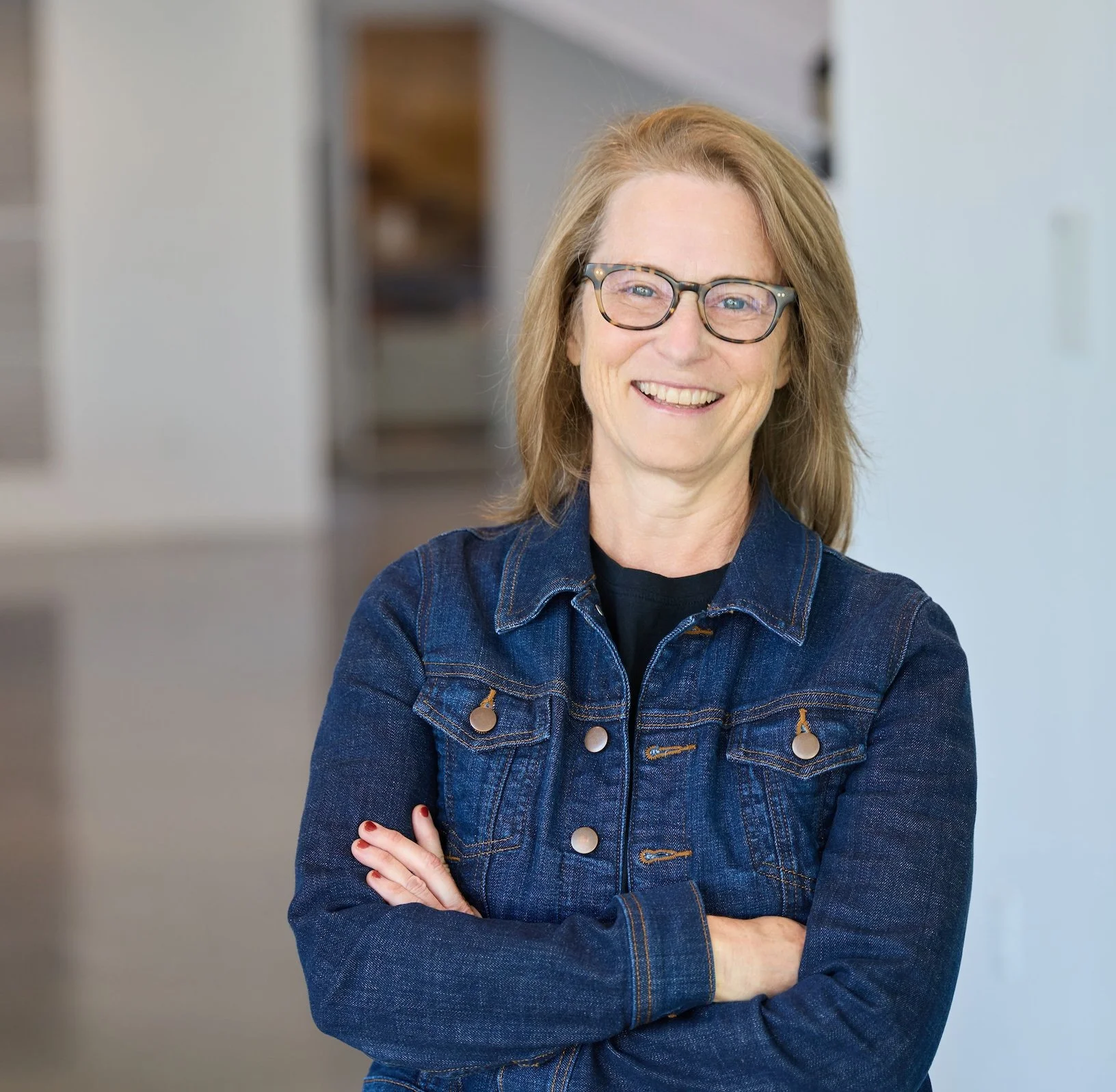
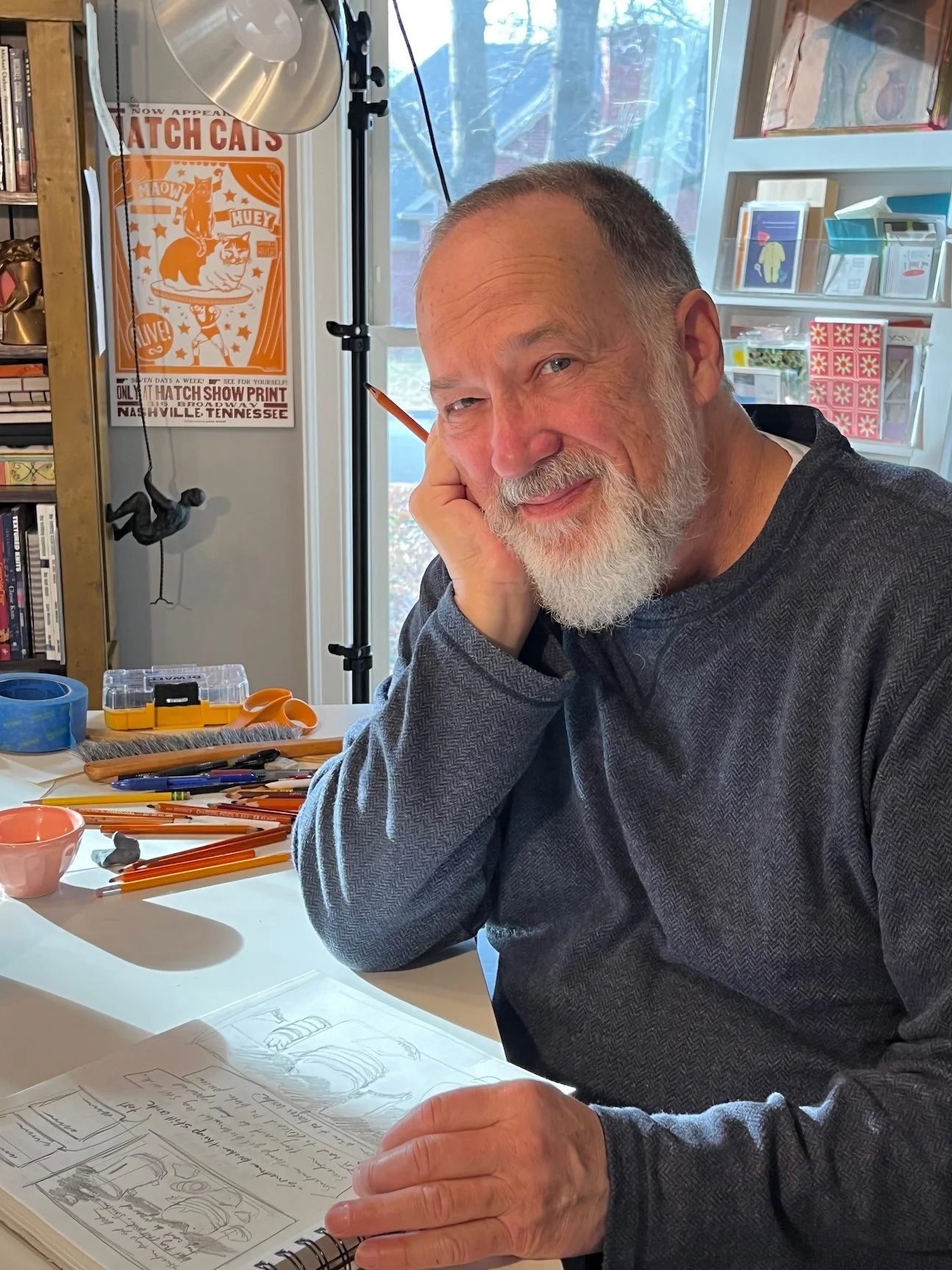
Jeff Young is an artist and educator from Central Arkansas. He earned a BFA in Art Education from Texas Tech University and MA and PhD degrees in Art Education from the University of North Texas. Jeff recently retired from the University of Central Arkansas where he taught art education and drawing for 29 years and served as chair of the Department of Art and Design from 2003-2018. He has exhibited his work in 48 regional and national juried exhibitions, has presented at over 50 state and national conferences, and is co-author on six articles published in journals such as Studies in Art Education and Visual Arts Research. His work, primarily in charcoal, pastel, graphite, and hand-made paint, is about relationships among friends and family and the memories they create. Jeff is a member of the Central Arkansas Collective, where more of his work can be found as well as at his Instagram. —2026
AAS: Jeff did you grow up in Arkansas?
JY: I was born in Oklahoma, raised and schooled in Texas, and moved to Arkansas 30 years ago. After earning a BFA in Art Education at Texas Tech University, I started teaching elementary art in Arlington, Texas. During the next ten years I continued teaching and completed an MA and PhD in Art Education at the University of North Texas. After teaching art in public schools in Arlington and Coppell, Texas for 12 years, my family and I moved to Conway with my position as a faculty member at the University of Central Arkansas (UCA). Moving from Dallas, we enjoyed the smaller city life, tall trees, and fall, which doesn’t happen in Texas.
AAS: Did you have any artist or art educator role models growing up?
JY: In junior high, a childhood friend showed me a linoleum print he had made in his art class. It was a cartoonish outline of the profile of a face with flowers spewing out of the mouth. He loved the class and the teacher - Sonya Haynie. I signed up for her art classes for the next two and a half years. Sonya was enthusiastic, knowledgeable, and liked working with junior high kids. It was in her class where I discovered I could draw; I still have my sketchbook from her classes. From there, Judy Griffin nurtured me through high school, and it was during that time that I decided I wanted to be an art teacher. The BFA program at Texas Tech allowed me to explore a wide range of studio classes - watercolor and oil painting, ceramics, printmaking, jewelry, sculpture, fibers, and drawing. There was a great art education and studio faculty at Tech, all active in their disciplines. It was there that Betty Street, who taught fibers and art education, said “You ought to think about graduate school and teaching at the university level.” She introduced me to Jack Davis, who was an art education faculty member and chair of the art department at the University of North Texas. Jack and his colleague Connie Newton were dedicated mentors for my art education development. While working on the MA and PhD, I focused all my studio courses on drawing and was fortunate to work under Claudia Betti, Henry Whiddon, and Vincent Falsetta.
“Drawing lends itself to storytelling. Most of my work has a narrative thrust.”
AAS: What I love about your work is that your drawings appear deceptively simpleand straightforward. But there is usually a story or life lesson, hidden or buried within. Do you agree?
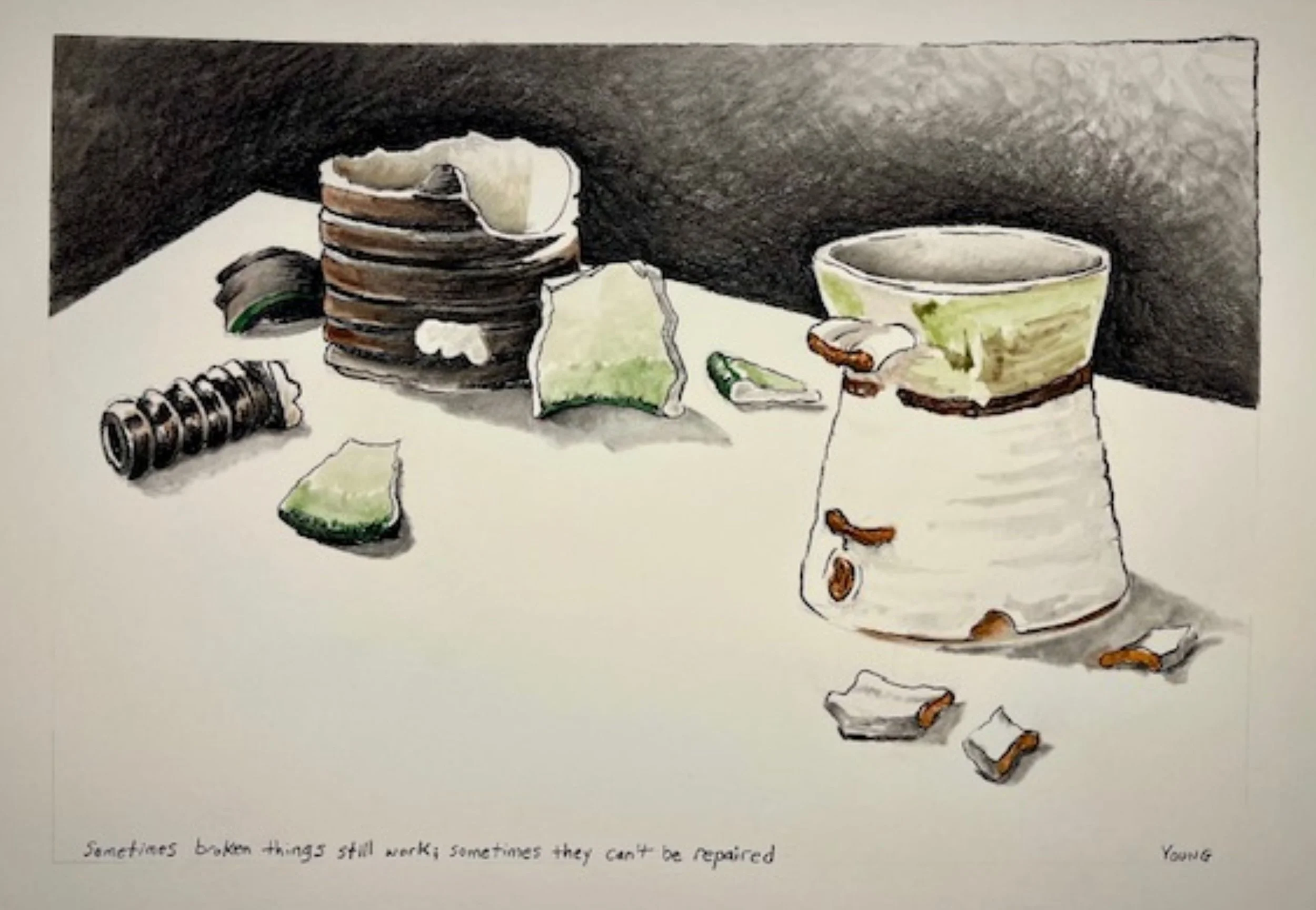
JY: Yes, I do agree with what you are saying. Helen Phillips, a beloved colleague with whom I was fortunate to work with at UCA, used to say she could “find meaning in a blade of grass and a ball of snot.” I tend to be reflective, so to me, a coffee cup with a broken handle that’s still functional can become a metaphor for relationships that have been tested but endure and become stronger. The go-to coffee cup in my cabinet is one Helen made 25 years ago. I accidentally broke almost all the handle off about 15 years ago, but it still works.
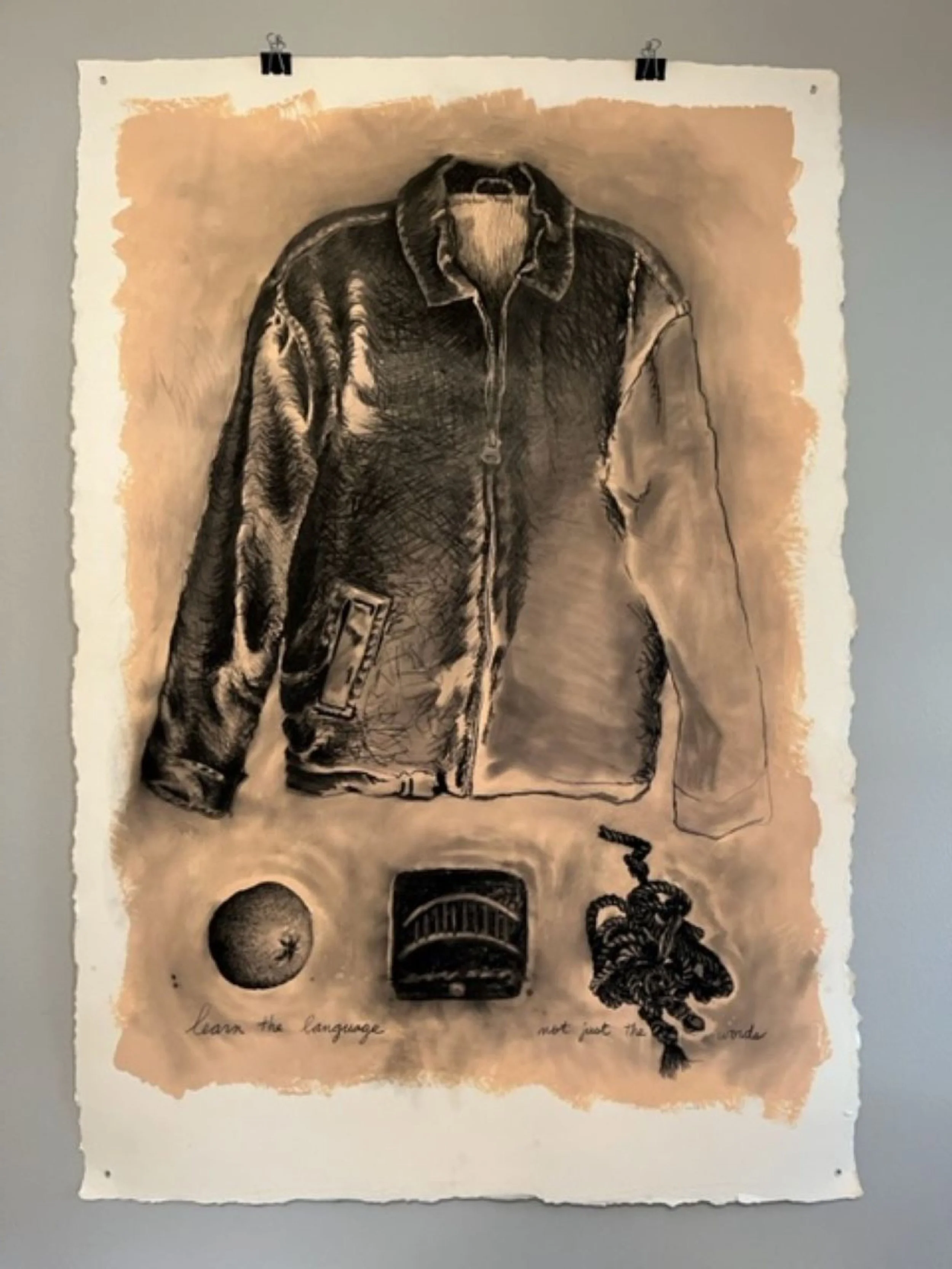
AAS: You have done several drawings where a jacket or coat becomes almost a security blanket for the subject of the drawing. Container: Helen’s Cup is one of my favorites. Tell me about it and your use of handmade paint.
Containers: Helen’s Cup, charcoal, handmade sandstone paint, and pastel on paper, 30” x 20”
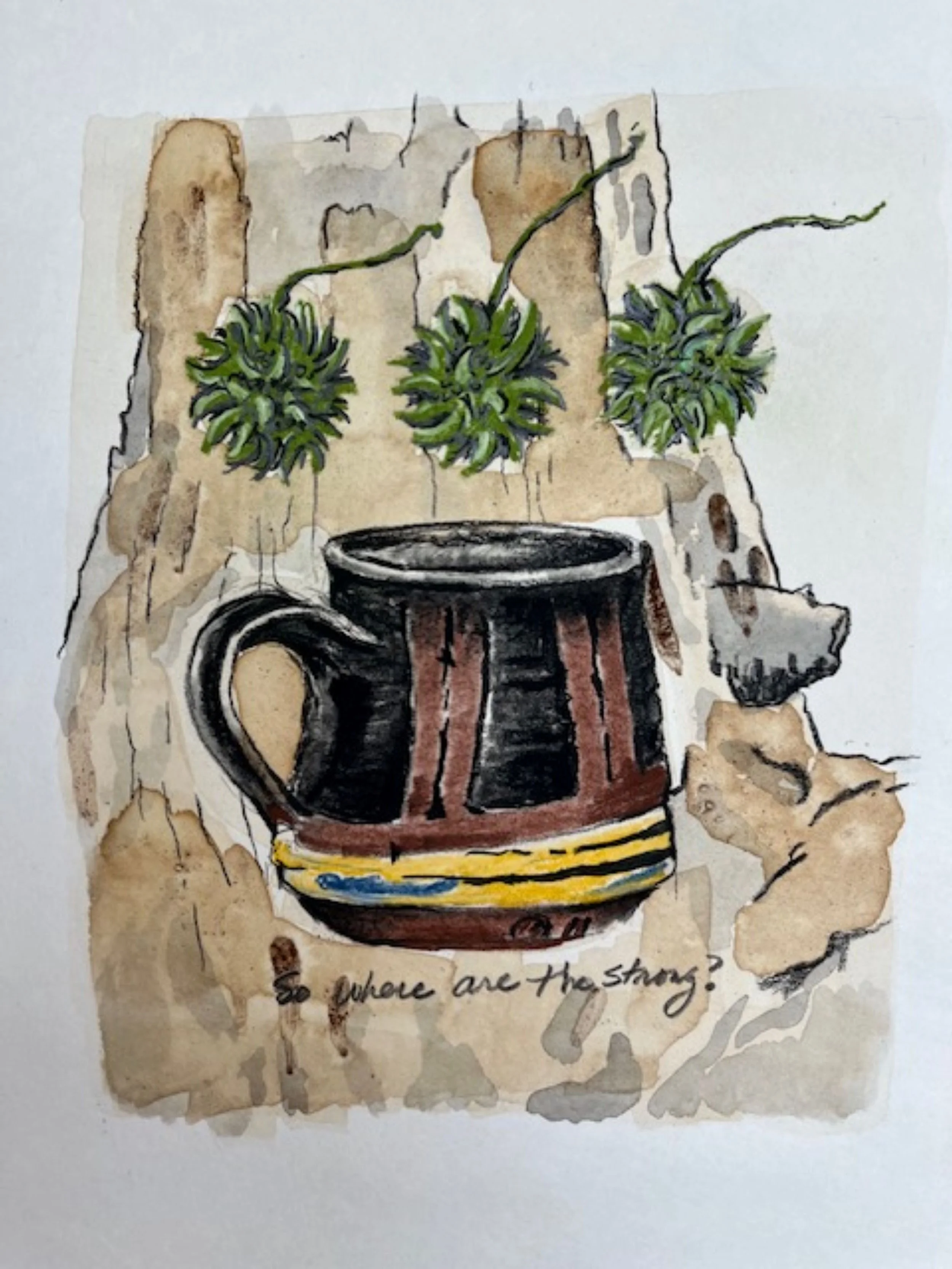
JY: I’m glad you “read” the coat as a security blanket. In my work, coats become symbols of protection for people I’ve known who have been hurt, child-like drawings become representations for who we really are, and sweetgum balls become metaphors for both pain and growth. And often, there is a story behind the work.
Helen’s cup, depicted here, is the cup I was just talking about. I put it inside a coat as a way to protect it from being broken further, which is a possibility because I use it weekly. The drawing also works to keep Helen’s memory alive. She was a well-known Arkansas artist and teacher.
The small pots underneath the coat are made by Melinda Lindsey, one of Helen’s students. The pots are small pinch pots that served as “tests” for the glazes she was using. My wife and I have owned these for 25 years.
The handmade paint is made from Arkansas rocks. A few years ago, I attended a workshop led by Madison Woods at the Historic Arkansas Museum. She led the participants through the process of making paint from rocks. She’s a great teacher. I loved the process, and it was a natural extension from my recent work using dirt on drawings.
AAS: I think Anniversary: It Was The Super-Easy Bird House is a good example of a relatively straightforward image — but with a very complex meaning? I will admit that I did a bit of Googling to try to understand its meaning, but I’m still not sure. Or maybe the “story” behind it is a ruse, which would make the drawing even more fun?
Anniversary: It Was The Super Easy Bird House, graphite on paper, 18” x 18”
JY: I love that you Googled to find possible meanings! The drawing is based on a real story and is part of a triptych in which I was playing with explaining visual metaphors in my work. But I didn’t want to make it too easy to connect-the-dots. Probably the only thing you would find online that relates to the work would be the bird on the mountain which references Native American lore tied to Thunderbird Mountain in the Franklin Mountain range near El Paso, Texas. When my brother Gregg and his family lived in El Paso, he made a bird house for his wife as an anniversary gift. Somehow, during construction, he used the wrong screws. He used 4” wood screws which then protruded far into the nesting area of the birdhouse. So, instead of creating a safe haven, he had accidentally created a torture chamber.
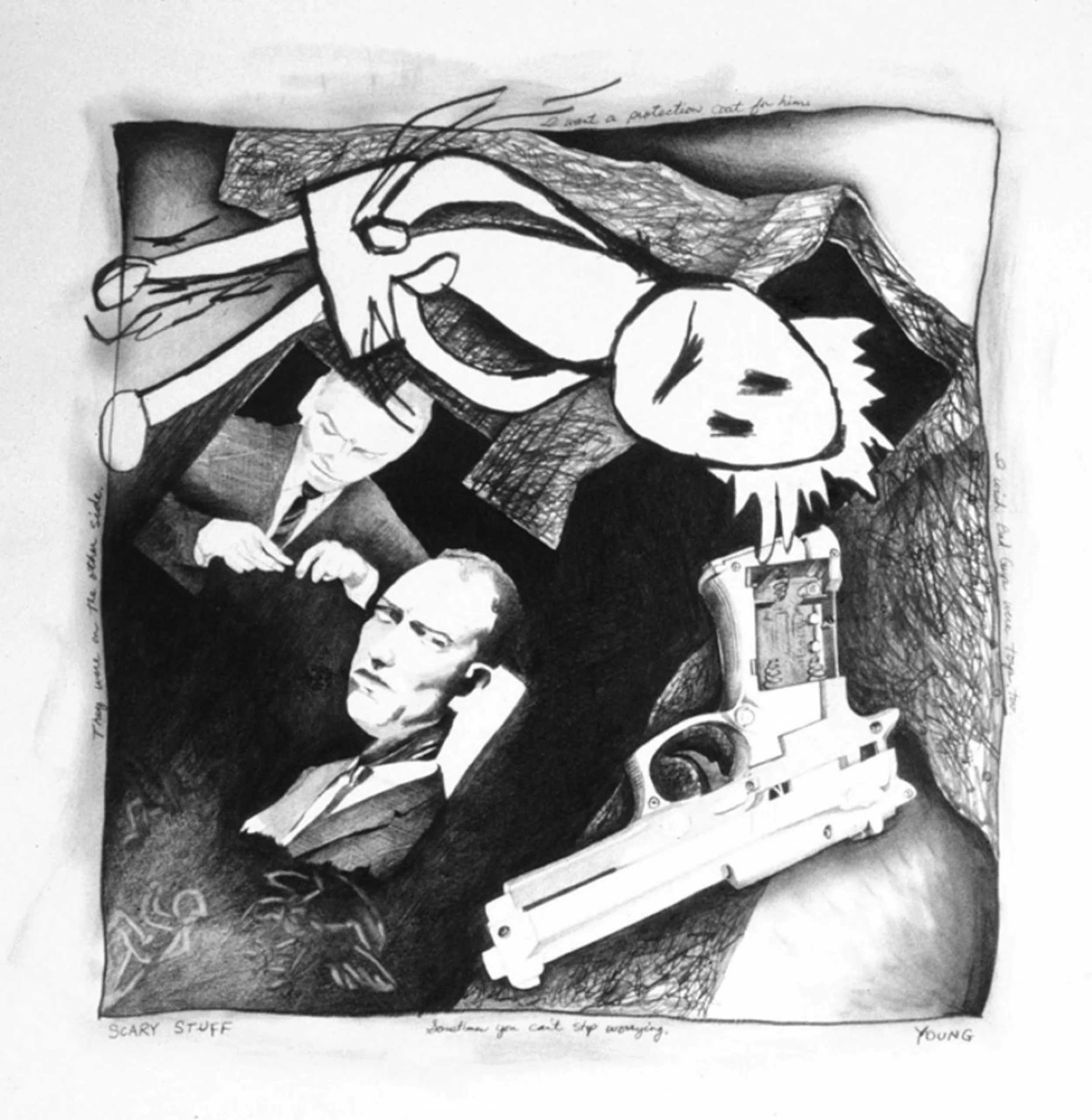
The “big hand” referred to in the text below the drawing is a personal symbol. When my daughter Colleen was a child, she had drawn a picture of her and a friend being chased by a large hand. When I asked her about it she said, “Oh, that’s the Big Hand. It’s scary, and it’s chasing us.” So, I started using gloves in my drawings to symbolize the bad things that happen to us in life. That’s why it says, “In this drawing the big hand is 4” wood screws.”
AAS: True Stories of My Childhood: The Two-Headed Calf was drawn in both the hand of a child and in the hand of an adult and trained artist to tell a story from your childhood. I love that. But where do apricots and green beans enter the story?
True Stories Of My Childhood: The Two-Headed Calf, graphite on paper, 32” x 32”
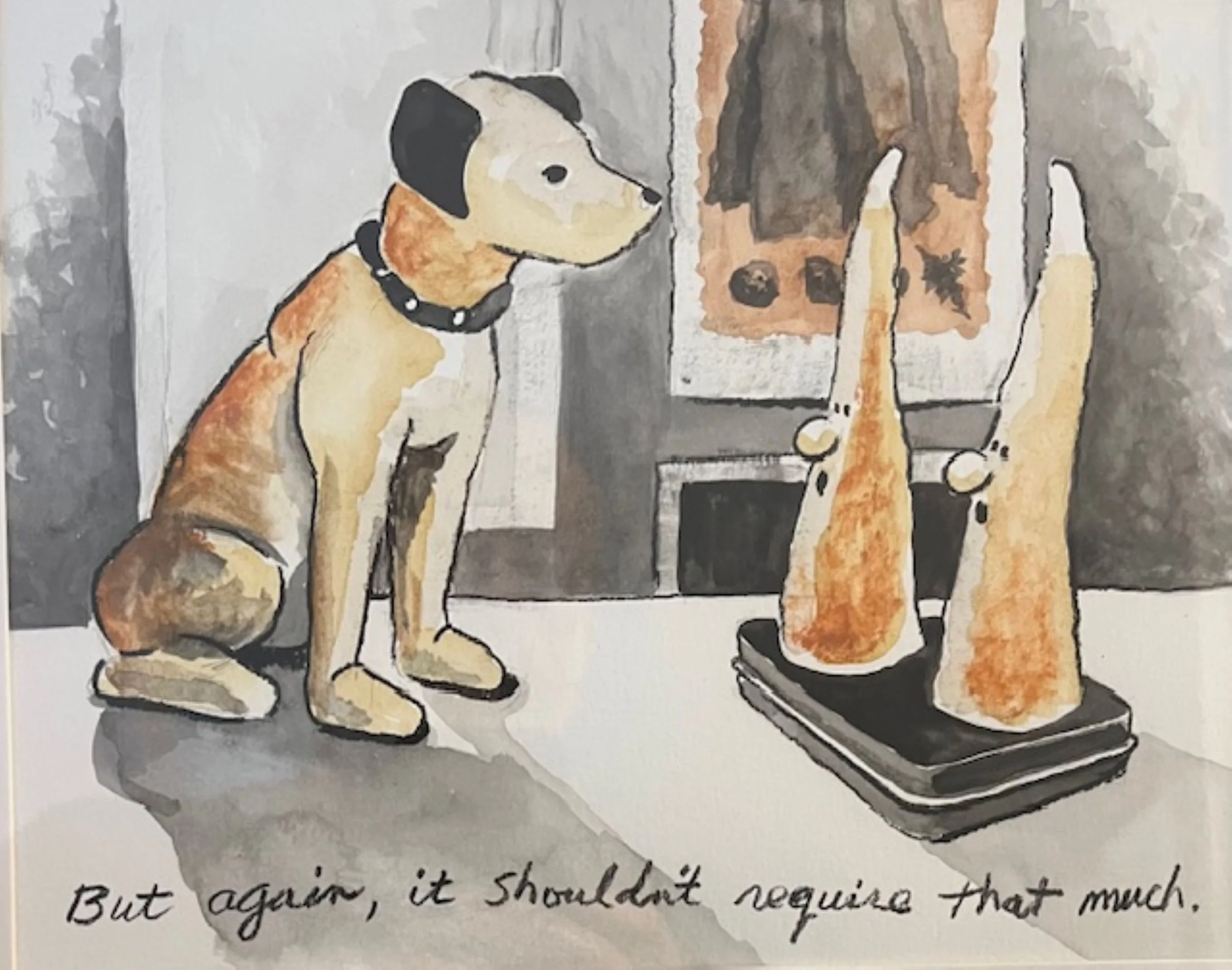
JY: When I was a youngster my brother and I would spend two weeks each summer with my paternal grandparents, who lived on a farm in Oklahoma. For excitement, my cousins and I would dare each other to “go look at the two-headed calf.” When my Uncle Dean was in 4-H, he owned a prize-winning cow. When she was having trouble delivering a calf, the reason was because the calf had two heads. In order to save the cow, the vet aborted the calf. For a science project, Dean placed the heads in formaldehyde in a large 5-gallon jar. After he moved off, my grandmother placed it in the fruit cellar — between the apricots and green beans. In the drawing, the jar is broken because one summer, when we were helping my grandmother clean the cellar, one of us (it was Gregg) accidentally knocked over the jar, and it broke. The hound dogs on the farm grabbed the heads and carried them off into the woods, never to be seen again — until a few days later. By the way, if you ask Gregg, he will tell you that I broke the jar. But it was really him.
AAS: Why do you think drawing became your preferred method of artistic expression?
JY: I love drawing for its simplicity, its practicality, and its expressiveness. Drawing lends itself to storytelling. Most of my work has a narrative thrust.
I think what I wrote for one of my artist statements sums it up best: Ernest Boyer, the educator, compiled a list of eight traits that all humans have in common. One of these human commonalities is our search for a larger purpose, our attempt to give meaning to our lives. For me, the making of art plays a part in that search for meaning. Thinking about the people I know, exploring their stories, and pondering nature helps me find my purpose.
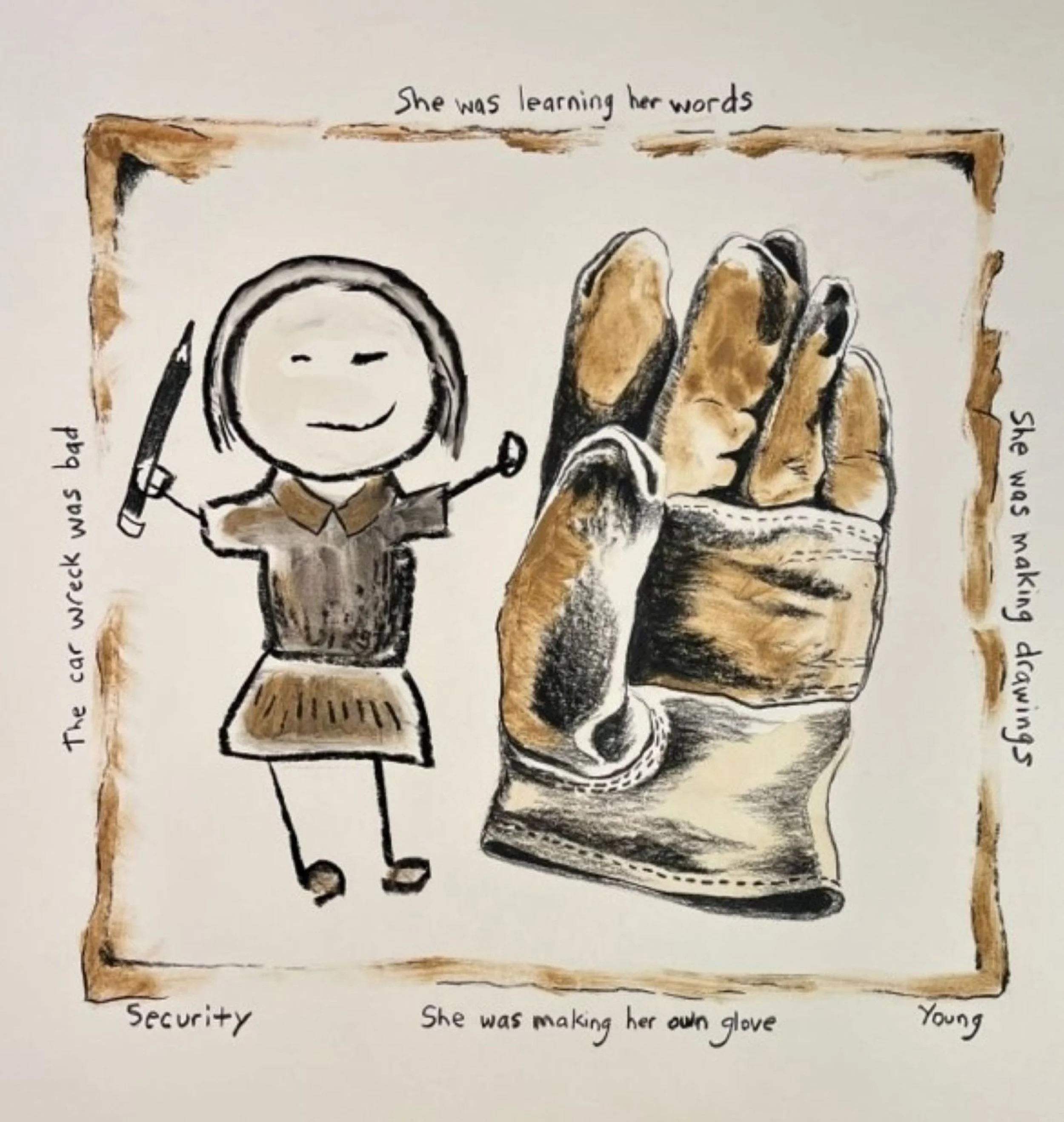
AAS: What is the meaning behind It Was A Good Glove? The way you carried the theme by using Arkansas dirt to color the drawing is wonderful.
Security: It Was a Good Glove, charcoal and Arkansas dirt on paper, 18” x 18”,
JY: A few years ago, I decided to re-purpose the visual metaphor of the glove and use them as metaphors for protection. So, I guess, sometimes gloves can be the Big Hand, and sometimes they can be a coat.
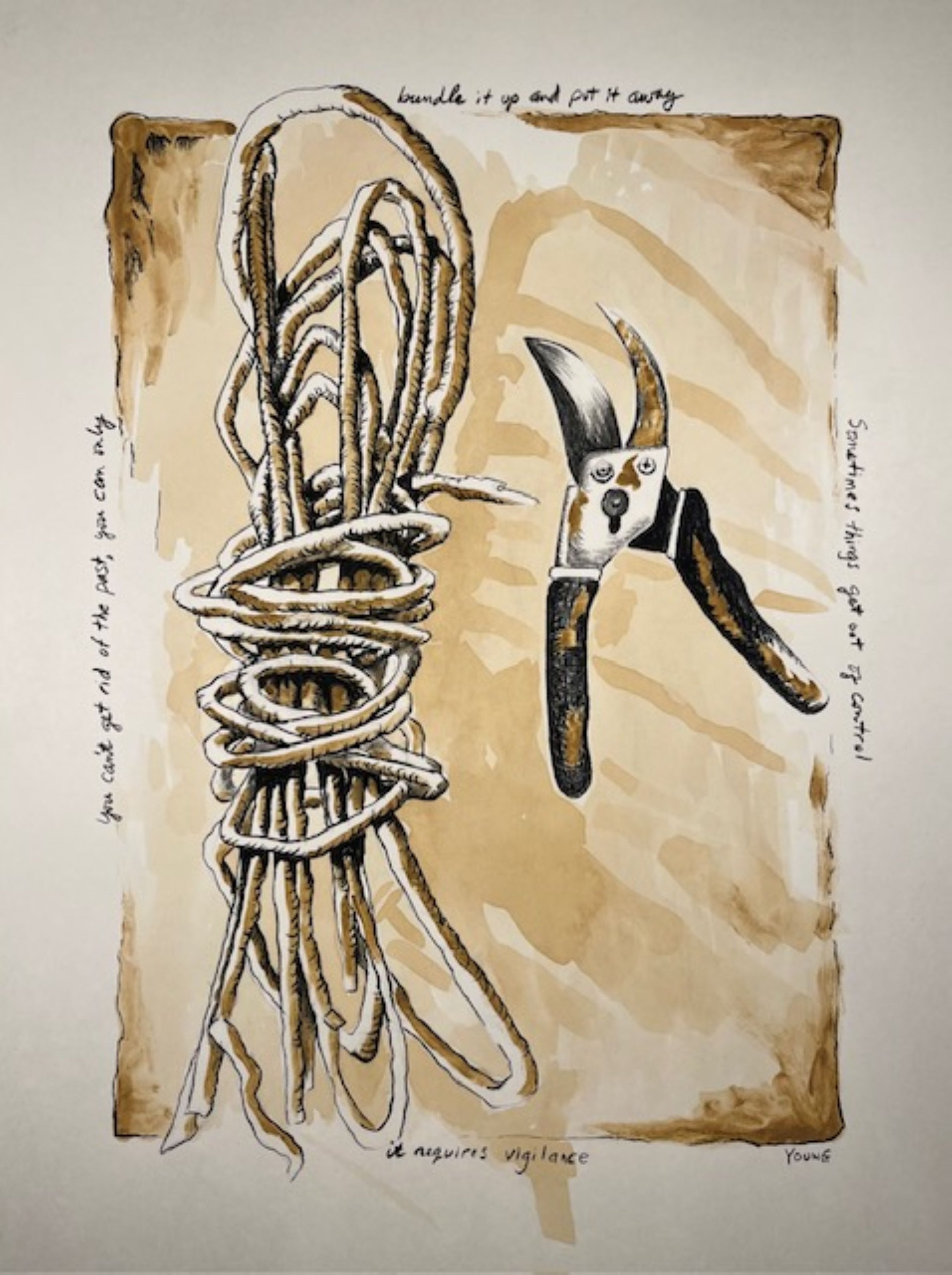
I had been working in the yard, and in my shed came across a toolbox full of old, worn gloves. I thought about how they had protected my hands from getting beaten up by yardwork and how gloves don’t have to always be “the Big Hand.” So, I made a set of eight glove drawings in which gloves served as protection for me or others from danger.
This specific drawing was one of the last of the eight, explaining how sometimes gloves protect us. In this drawing, it’s protecting the young girl from being too sick.
AAS: Looking back over your career, what do you think were some particularly memorable highlights?
JY: Interestingly, in a way, I don’t think about particular highlights. I feel fortunate that I was able to spend my entire career doing two things that I really love - teaching and making art. I appreciate all the students with whom I’ve worked, especially the last 29 years in the Department of Art and Design at the University of Central Arkansas. I’m thankful that Laura, my wife of 48 years, has supported my endeavors as a teacher and artist. And I’m thankful that Colleen and Calder, my daughter and son, served as endless sources of inspiration for work when they were young, and that now as adults they encourage me to continue making art.
AAS: Even in retirement you seem to keep pushing yourself. Perhaps you are now freer to experiment more or just draw for yourself? Seed Pods, Persistence is a fabulous drawing just done on an old lawn paper bag. What do you hope your retirement will be like?
Seed Pods: Persistence, charcoal, pastel, and handmade sandstone paint on an opened lawn leaf bag, 36” x 72”
JY: Thanks for the kind comments on Seed Pods. I’m hoping retirement will be giving me much time to be with family and make art. In the last couple of years, I have started working with groups of artists, which has provided opportunities to push myself. Seed Pods: Persistence was part of a body of work I made with a group of artists called “the Yard Crew,” comprised of Deborah Kuster, Barbara Satterfield, Kristen Spickard and myself, all Arkansas artists. The others discovered they had much work centered on the nature in their yards. They invited me into the group after seeing my recent work. Because I had been smearing dirt onto my work, and I was focusing on objects found in my yard like rocks, sweetgum balls, and sticks, it just made sense to draw on leaf bags themselves.
The other group I’ve been active with is the Central Arkansas Collective. I was invited to become a member a couple of years ago. We are an active group of thirteen artists all in the central Arkansas area. Last spring we created a new gallery space within The Studio Downtown, a coworking space in downtown Conway. We change our exhibits just about every month, and twice a year invite guest artists from around the state to exhibit with us. This spring our guest artist will be Tammy Harrington, who is a printmaker and paper cut artist from Russellville. Then, in the summer, Perrion Hurd, a printmaker and muralist from Little Rock, will be exhibiting with us.