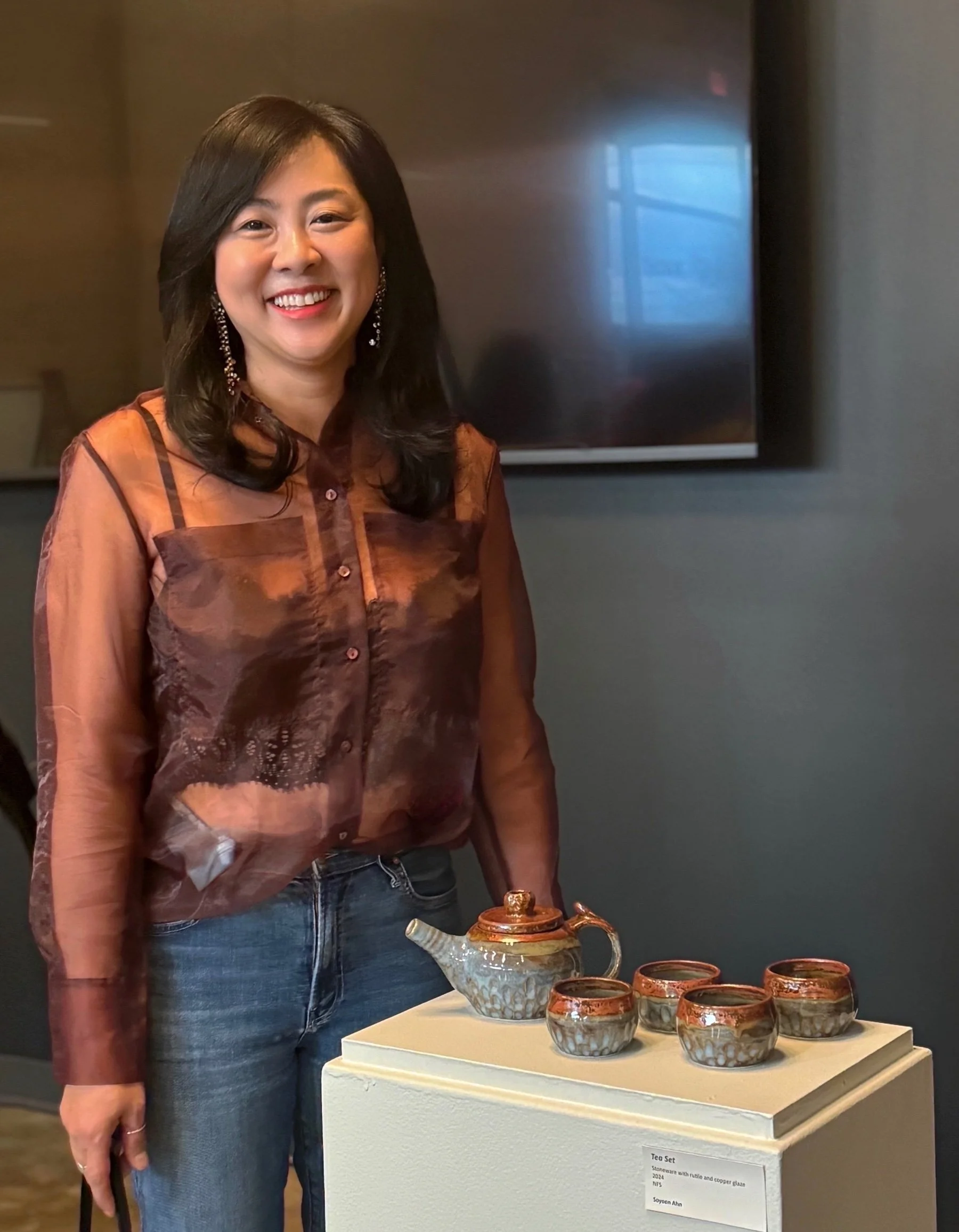
Interview with artist Soyoon Ahn
Soyoon Ahn is a potter and painter working in Russellville, Arkansas. Originally from Seoul, South Korea, her work draws inspiration from her Korean heritage and celebrates traditional Korean folk designs and motifs. Soyoon also teaches art at Arkansas Tech University and University of the Ozarks. Recently, she opened her own studio, where she teaches pottery to the community. More of Soyoon’s work can be found at Boswell Mourot Fine Art in Little Rock and at her website. —2025
AAS: Soyoon, tell me a bit about your background. Where are you from originally?
SA: I was born and raised in Seoul, South Korea. I pursued a career as a child psychologist after completing my Bachelor of Arts and Master of Arts degrees from Hanyang University. I later moved to Michigan to complete my doctorate, but life doesn’t always go as planned. Eighteen years ago I moved to Russellville, Arkansas.
AAS: So, art was really not something you thought much about growing up?
SA: No, my aspiration has always been to pursue a career in the arts, although I worked as a child psychologist. My father was a banker. But if he hadn’t had to choose that career to make a living, he probably would have been a great artist. He had a natural talent in art and he always loved to sketch interesting inventions and showing them to me. He was especially good at sculpture and sculpture was my favorite medium as a child too. In high school, I made a sculpture of Michelangelo’s David from a bar of bath soap and won first place!
I wanted to go to art school, but my parents had three children to support and my older sister was already pursuing a music degree. In Korea, entering art or music college costs a lot of money for private education. I was always interested in psychology as well as art, so I decided to study psychology and begin working.
AAS: When did you discover your love of pottery making?
SA: Despite residing in a fast-paced urban environment, I was always interested in slow-living, traditional folk art and especially the Korean tea ceremony. Korean tea sets embody the nation’s beauty through a philosophy of subtle elegance, harmony with nature, and appreciation for imperfection. This aesthetic is deeply influenced by Confucian and Buddhist ideals, resulting in designs that are both functional and artistic. This led me to pursue pottery making.
When I moved to Russellville, I was introduced to Winston Taylor, an Arkansas Living Treasure in 2011. He guided me toward my passion for ceramics. He was the former artist in residence at the River Valley Arts Center and a raku-firing artist. I was astounded by the transformative power of raw clay, witnessing it transformed into intricate creations by the skillful artist’s hands. This experience prompted me to complete my Bachelor of Fine Arts in fine art degree at Arkansas Tech University.
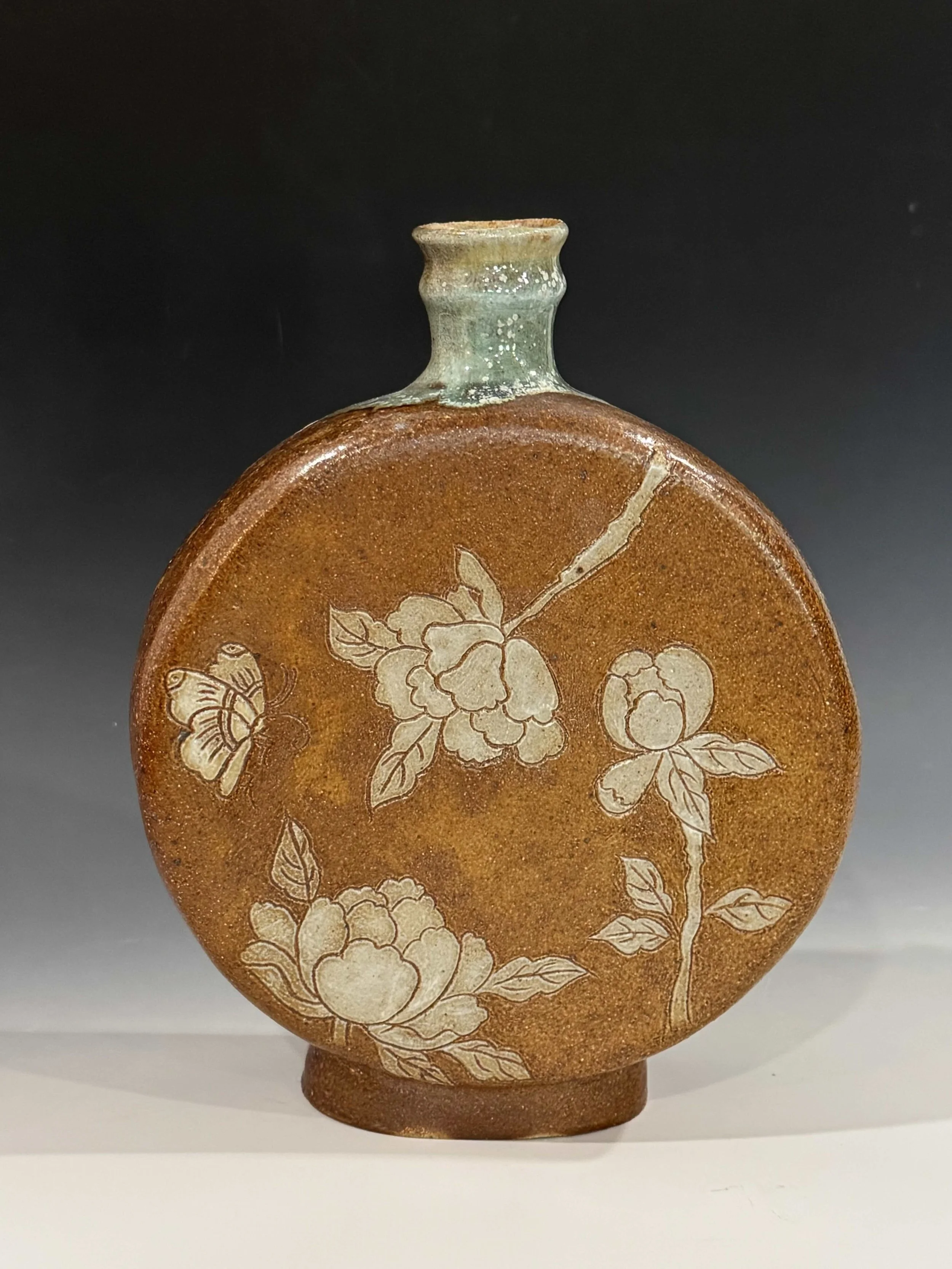
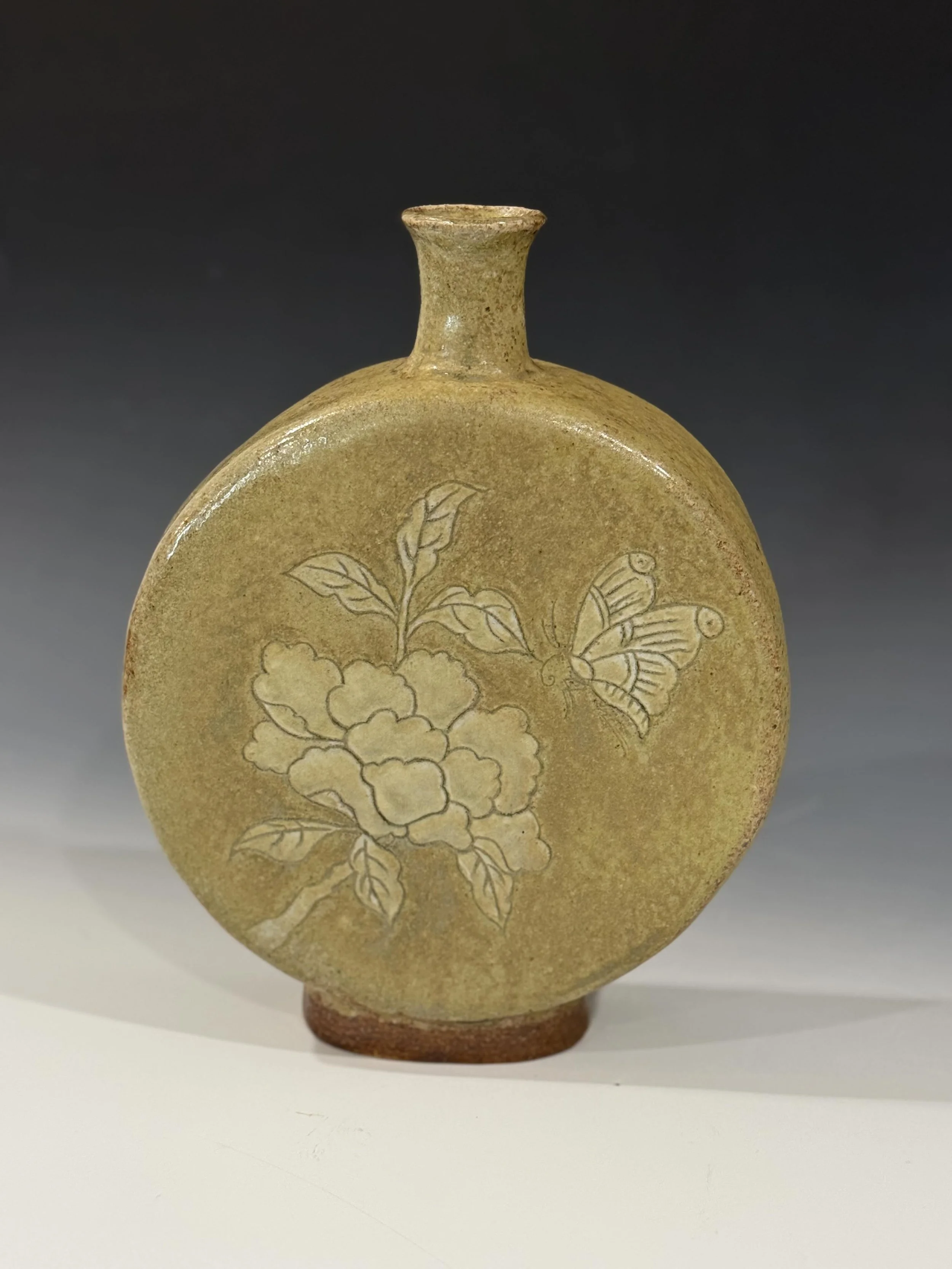
“My work is inspired by Korean Pyeonbyeong, a traditional Korean flat flask, which was primarily produced during the Joseon Dynasty (14th-19th Century).”
Morando Korean Flat Flask, stoneware, 9.5” x 8” x 2.5”
AAS: I want to ask first about your traditional Korean flat bottles. What is the significance of their shape and decorations?
SA: My work is inspired by Korean Pyeonbyeong, a traditional Korean flat flask, which was primarily produced during the Joseon Dynasty (14th-19th Century). This unique flattened, globular form was developed to facilitate transportation and storage during travel. My flasks are constructed using slab, soda and wood firing techniques. I am also a painter, so I incorporated Korean traditional folk-painting design into the flask by applying porcelain slip and sgraffito techniques.
AAS: Your lovely tea pots and cups are both decorative and functional. Are they also in traditional Korean style?
Elm Leaf Tea Set, stoneware with eggshell wash, 8” x 5” x 5”
SA: Yes, they are also traditional Korean style. I have incorporated a contemporary aesthetic to the traditional Korean teapot design by changing a handle design to a more contemporary style. In the Elm Tea Set, I used the elm leaf motif because elms are prevalent in Arkansas. Elms are also native to Korea and have historically been utilized for Korean herbal medicine and tea production. To convey purity, I used an eggshell wash.
As I mentioned, most of my work in inspired by the work produced during the Joseon Dynasty. During the Joseon era, aesthetics shifted towards simple, pure white porcelain, which symbolized the era’s dominant philosophy, emphasizing purity, discipline, and minimalist elegance. I tried to express those concepts in my Elm Tea Set.
AAS: Nostalgia is one of your wonderful face teapots. Tell me about it and the importance of decorative and functional ceramics and pottery in Korean culture and tradition.
SA: Korean pottery is vital because it blends deep spiritually, national identity, and daily functionality, serving practical needs like cooking, storage, while embodying the Confucian ideals of purity and simplicity.
Joseon white porcelain reflects Confucian ideals. White porcelain is classified into categories such as pure white porcelain, blue-white porcelain, iron-brown glazed porcelain, and copper-red glazed porcelain. These classifications differ based on the type of clay, glaze, and decorative techniques used such as blue underglaze or iron oxide decoration. I opted for white porcelain and tried to create blue-white porcelain employing cobalt blue.
Nostalgia, face teapot, porcelain with cobalt carbonate and gold overglaze, 7” x 10” x 6”
Nostalgia, reverse
AAS: You also create more sculptural vessels. Middle Aged Woman is one I really love and the glaze is terrific. Tell me about it.
Middle Aged Woman, stoneware with celadon glaze, 10” x 7.5” x 7. 5”
SA: I will be creating more of this type of sculptural vessel and you can meet them at Boswell Mourot Fine Art. Middle Aged Woman is one of my representative works. I have received several awards for this work and Arkansas Tech University has purchased it for their permanent collection.
At that time, I was thinking of my artistic identity as a bicultural artist, grappling with the loss of my father, and the physical changes that come with middle age. I attempted to express the sorrow and the struggle of the woman in the society. I chose green celadon glaze to convey this message and evoke a specific mood.
“I was a perfectionist and preferred to be in total control. However, pottery transformed my perspective, shifting my focus from the outcome to the process itself.”
AAS: You mentioned Winston Taylor. When I interviewed him several years ago, I asked him if he enjoyed the spontaneity and surprise associated with glazing and firing. He said he honestly did not — I think he likes to be in total control. How do you feel about the uncertainty of the process and what is it about pottery making that excites you?
SA: I was a perfectionist and preferred to be in total control. However, pottery transformed my perspective, shifting my focus from the outcome to the process itself. It also instilled in me a mindfulness approach, encouraging me to embrace imperfections, and adopt a slower pace to connect with the clay’s tactile sensations. This transformation transformed each step into a meditative, present moment experience, rather than a race to achieve perfection. Consequently, I developed a patience in my creative flow.
Recently, I have become to appreciate the more uncertainties of the process after learning wood firing from Stephen Driver, former professor of art at UALR, owner of Little Mulberry Gallery in Ozarks. He is an Arkansas Living Treasure in 2025 for his woodfired pottery and sculptures. Wood firing embraces spontaneity by allowing fire, ash, and flame to create unique, unpredictable surfaces. Despite the intricate processes, the delightful surprises are highly rewarding for potters and foster a profound connection to nature. I feel like I am becoming a real potter through this journey.
AAS: You just had a show at Boswell Mourot Fine Art in Little Rock. What was the response like to your work?
SA: I think that those who saw my work appreciated the unique form and beauty of the Korean design and its meanings. Also, people complimented me on the harmony between tradition and contemporary styles.
It’s an honor to be one of the artists represented by the Boswell Mourot Fine Art gallery. I am particularly honored to be exhibiting with Mark Blaney, an artist whose work I hold in the highest regard. Also, I am glad to know abstract artist, Sharon Locke. I extend my sincere gratitude to Kyle Boswell, Teresa Bennett Sorrentino, and the entire gallery team for their work in curating, organizing, and promoting this exhibition. My teapot sets and flat flasks will be displayed until January at the gallery.


AAS: Tell me about the art program at Arkansas Tech University and what you teach there.
SA: I ‘ve been teaching drawing classes and 2D designs at Arkansas Tech University for four years. I believe that the art program at Arkansas Tech University is the best of the best. The program’s emphasis on hands-on studio experience and the availability of each lab, including ceramic, sculpture, painting, printmaking, graphic design, and game design studios, has made a significant impact on the skill-set development of its art students.
Our art faculty is a wonderful team. Each faculty member actively pursues their own career in their respective fields and collaborates with local artists and the community. Recently, the professor of art, Neal Harrington, dedicated his artwork Arkansas As Home at Clinton National Airport. ATU and all faculty are so proud of him.
Also, I am excited about my new journey at the University of the Ozarks in Clarksville. I am teaching ceramics there. The students and I have been researching ancient pots and that has been a huge success. We’ve studied surface decorations and coil-building technique and it has been a pleasure to see each student developed their own style from their own heritage.
The University of the Ozarks introduces student and faculty to artists through the Artist of the Month Series in in the Walton Fine Arts Center in Clarksville. Arkansas clay artist Barbara Satterfield was recently exhibited there and my students really enjoyed seeing her work. You can see my exhibit in there in January. I will introduce my work inspired by Joseon Dynasty pottery.
AAS: I believe last year you established your own independent teaching studio. What classes do you offer and what types of students are you teaching?
Soyoon’s pottery teaching studio.
SA: In 2024, I proudly established my art studio ‘Atelier A.’ in the heart of downtown Russellville. I offer pottery classes in wheel throwing and hand building to the local community, fostering their artistic growth and appreciation for this craft.
The reason I established my studio in downtown was that I wanted to serve the local community and hope this place will be a bridge connecting local artists and the community. So far, all students are beginners and have little to no experience with clay. People from diverse professions and age groups come to the studio: artists, counselors, doctors, nurses, foresters, police officers, teachers, business owners and more. They are all people who want to find a moment of rejuvenation by working with clay. Clay is the most basic medium that connects people to nature. I feel the greatest happiness when I see them finding a moment of renewal through working with clay and returning their life.