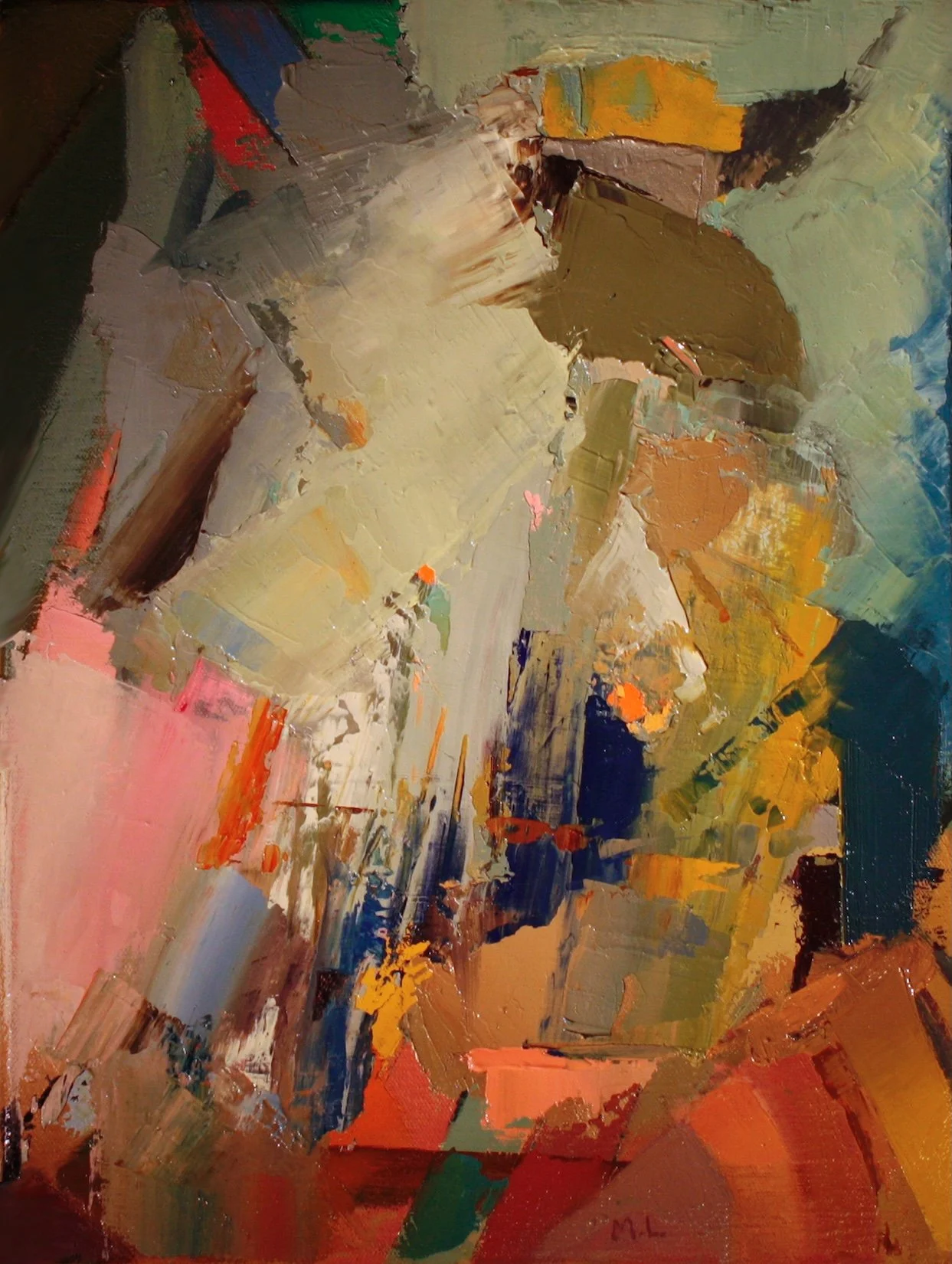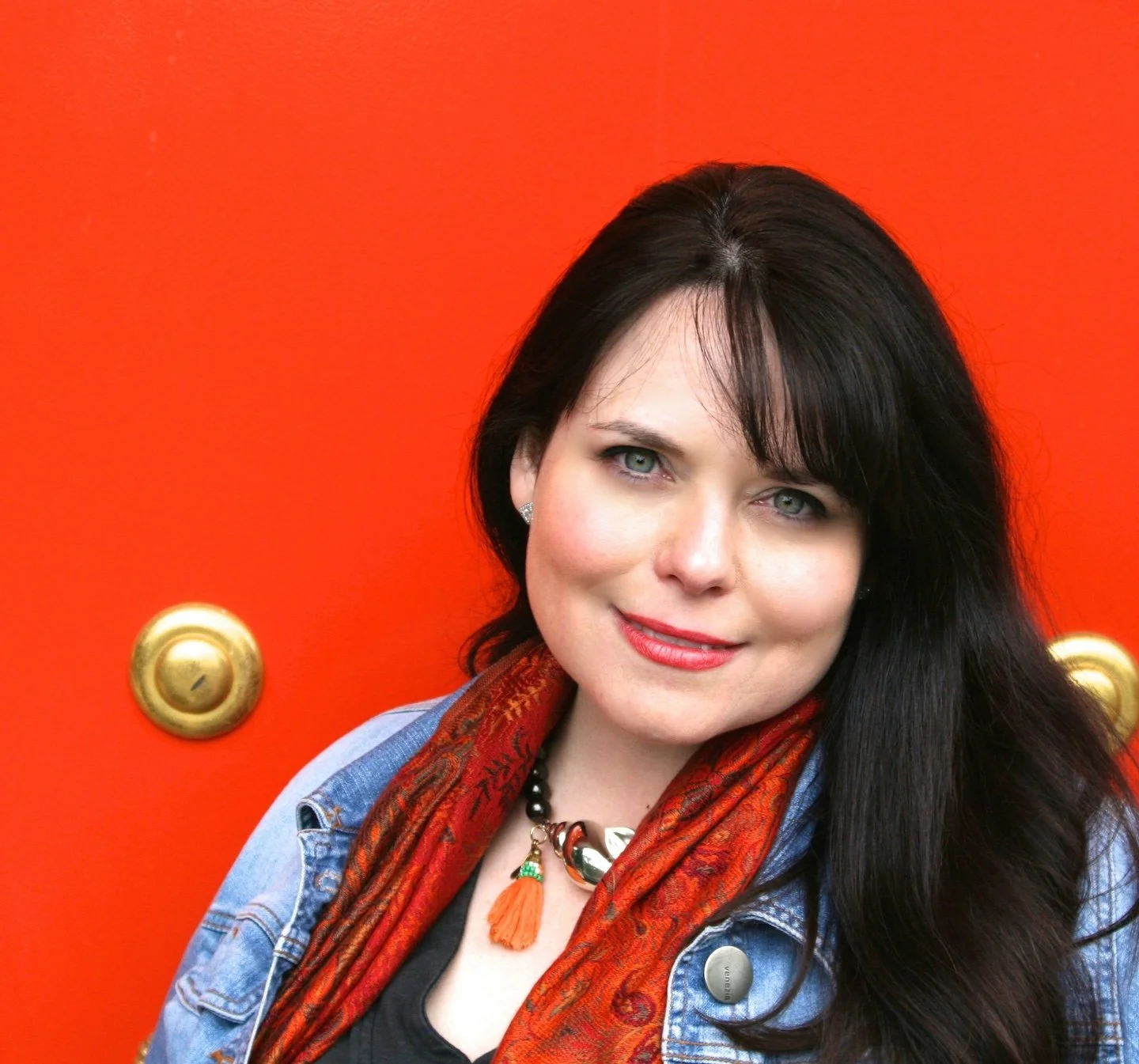
Interview with artist Michael Lierly
Michael Lierly is an artist and educator from North Little Rock. After earning a BFA in Illustration from the School of Visal Art in New York City and an MFA in Painting from Indiana University, Bloomington, he worked as an artist and taught in Indiana and California. In 2021, Michael returned to North Little Rock and teaches at the University of Central Arkansas, Hendrix College and Arkansas Museum of Fine Arts. More of his extraordinary paintings can be found at M2 Gallery in Little Rock and at his website michaellierllyart.com. —2026
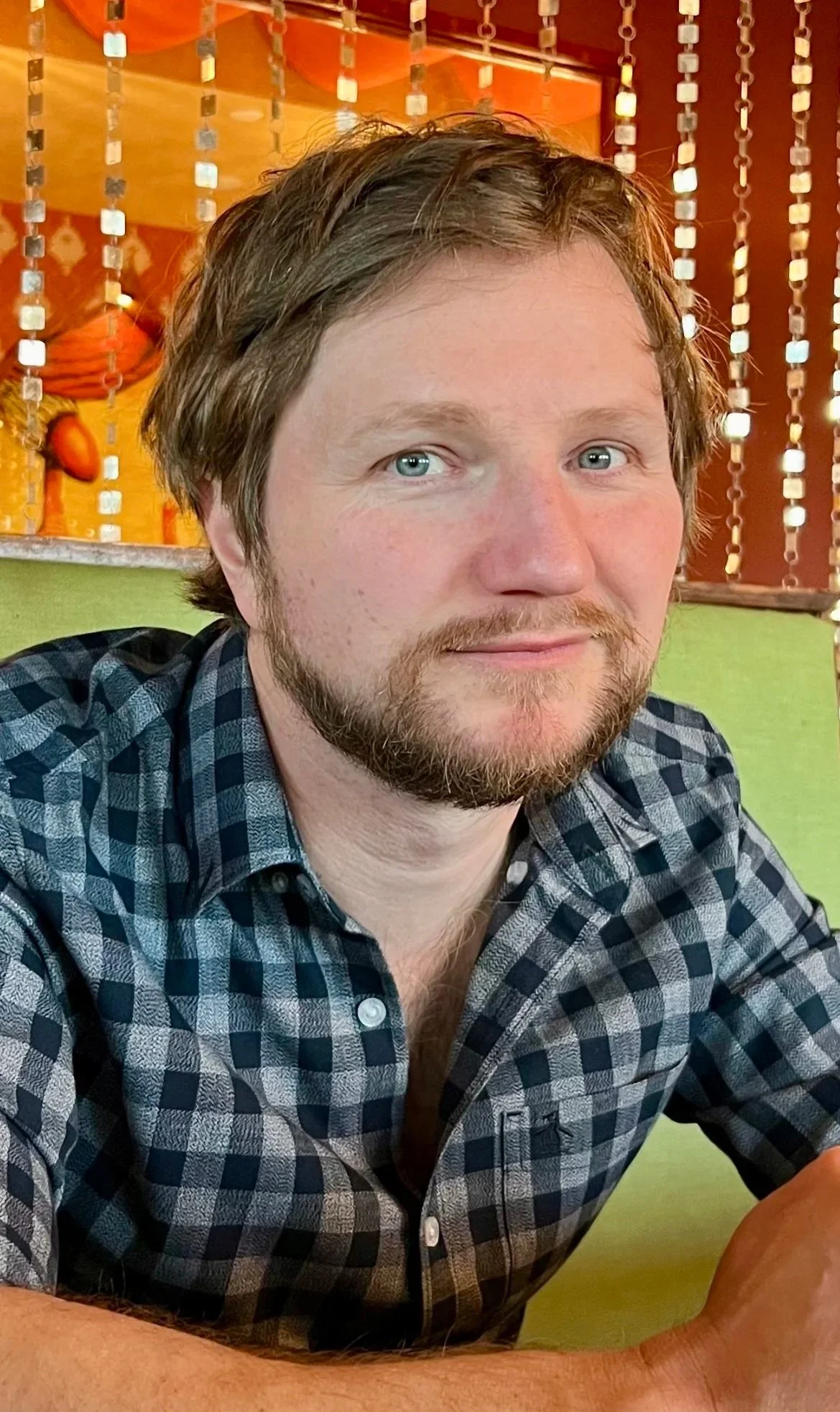
AAS: Michael, I know you lived and worked all around the US. Where did you grow up?
ML: I grew up in North Little Rock and went to schools in Little Rock at Horace Mann and Central. I went away to art school first to The School of Visual Arts in Savannah, Georgia and then when it closed, I moved up to New York City to finish my undergraduate BFA in Illustration and a minor in Art History. I lived in Queens for a year after school and then moved to Providence, Rhode Island to live with friends. I traveled around Europe and then eventually moved in with some friends into a studio space in Kansas City Missouri. I moved back to Little Rock and into the Kramer school for a few years until deciding to get a graduate degree at Indiana University, Bloomington.
AAS: What brought you to Arkansas?
ML: After my MFA from IUB, I taught there as an adjunct instructor. I also got to teach a program for IUB in Florence, Italy. Then I taught for a few years at the Herron School of Art and Design in Indianapolis before deciding to move to Los Angeles. During a decade of living in LA, I taught at five colleges and got to show my works in several galleries throughout Southern California. I met my now wife, Marian there and decided we wanted to try to buy a house and have children somewhere affordable, so we moved to North Little Rock in 2021. I became an instructor at the University of Central Arkansas teaching Studio and Art History Classes. I also teach a class at Hendrix College and night classes at Arkansas Museum of Fine Arts.
“Art to me is the closest thing we have to a bridge between our inner private world and the outer world we share.”
AAS: I guess simply put, you enjoy painting people. Before we start talking about some of your extraordinary drawings and paintings, what fascinates you about the human form and especially the face?
ML: Art to me is the closest thing we have to a bridge between our inner private world and the outer world we share. In other words, our psyche, soul, self, consciousness — whatever you want to call it — remains interior and inaccessible most of the time. But art rearranges aspects of our shared outer world or formal aspects of the world we share, such as lines, shapes, values, textures, colors, space, time, to make it express some aspects of our interiority.
Bodies and especially faces are also a bridge between the worlds. Both are extremely expressive as any dancer or actor knows well. So, depicting faces in art that is attempting to directly paint our interior states as my art attempts to do, is a way to bridge back to the shared world from the inside out. Faces are also as subtle as you can make them, and as difficult to get right as anything is in art, and so endlessly challenging and fascinating to me.
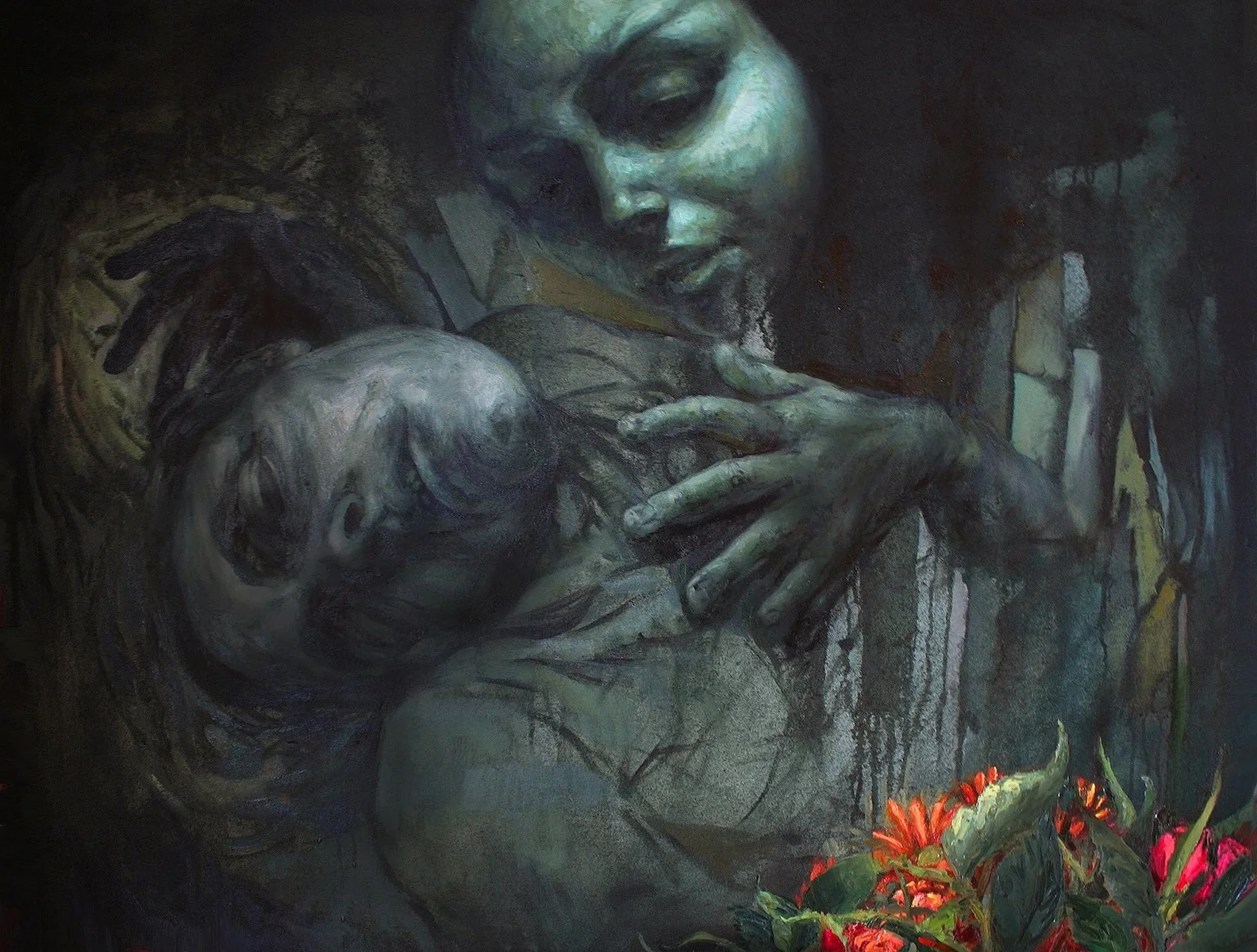
AAS: I want to ask you first about your drawing Tyche. Was that drawing for a particular project? It is a somewhat darker interpretation of her.
Tyche, 31” x 23”, charcoal and pencil on paper
ML: Tyche was a happy case of something I was wanting to draw beforehand that was close enough to a commission that I could pretty much draw something I wanted to do anyway as a job. In this case, for a poster for a band called Pallbearer that my brother, Mark plays drums for. It was drawn between cover art for two of their albums- Heartless and Forgotten Days.
Tyche is the Greek goddess — for the Romans it was Fortuna — that can represent the capriciousness of fate for good or ill. Nothing tempts fate. Both cosmic (big hands) and prosaic (small people) like having babies, as I have since learned in my own wonderful and terrible experiences of having children.
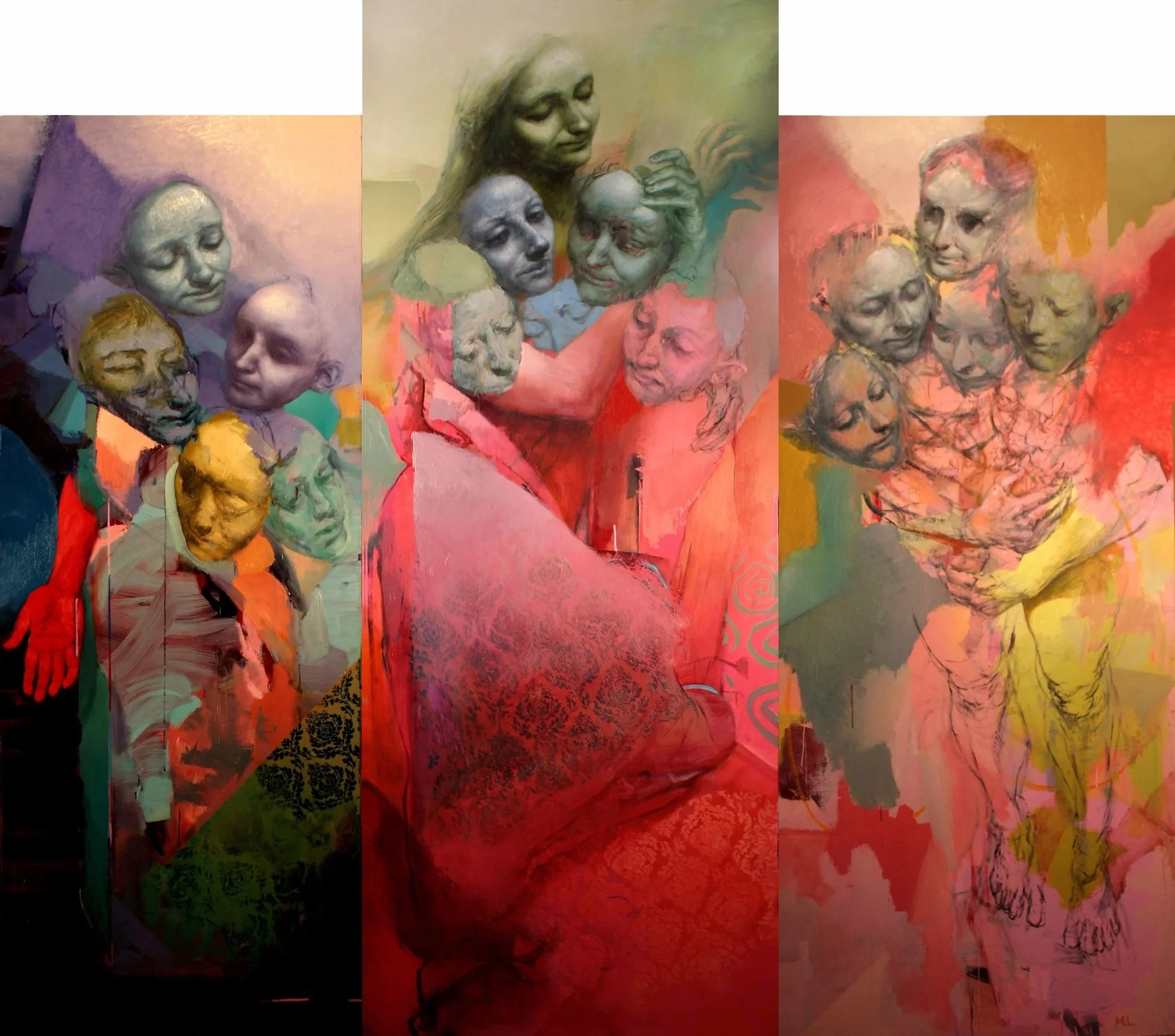
AAS: I love the way you use color and placement to create a mood that is often confining but not tense. Fettered is a good example of that, I think. Tell me about that painting and the often dreamlike or unearthly settings of your paintings.
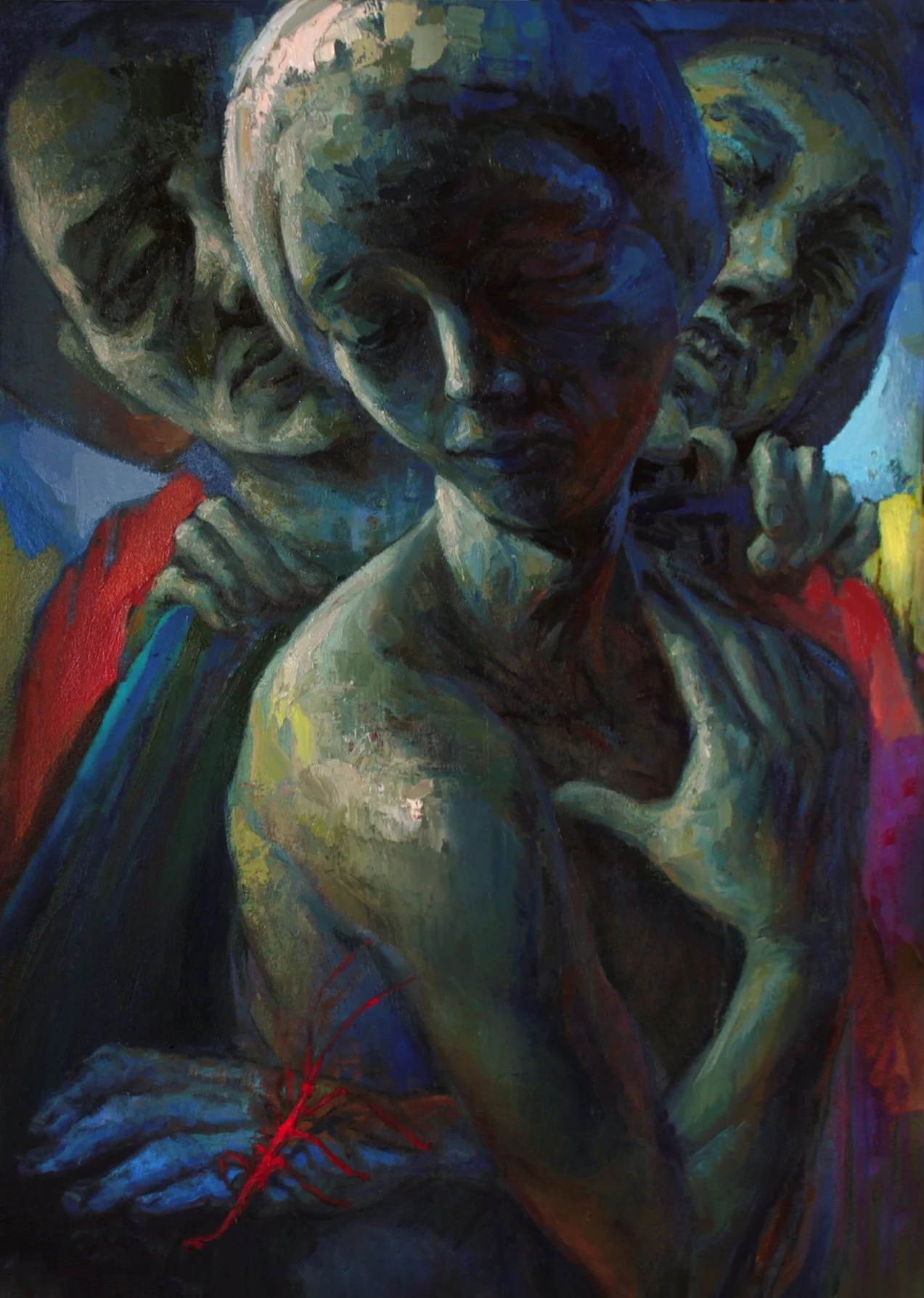
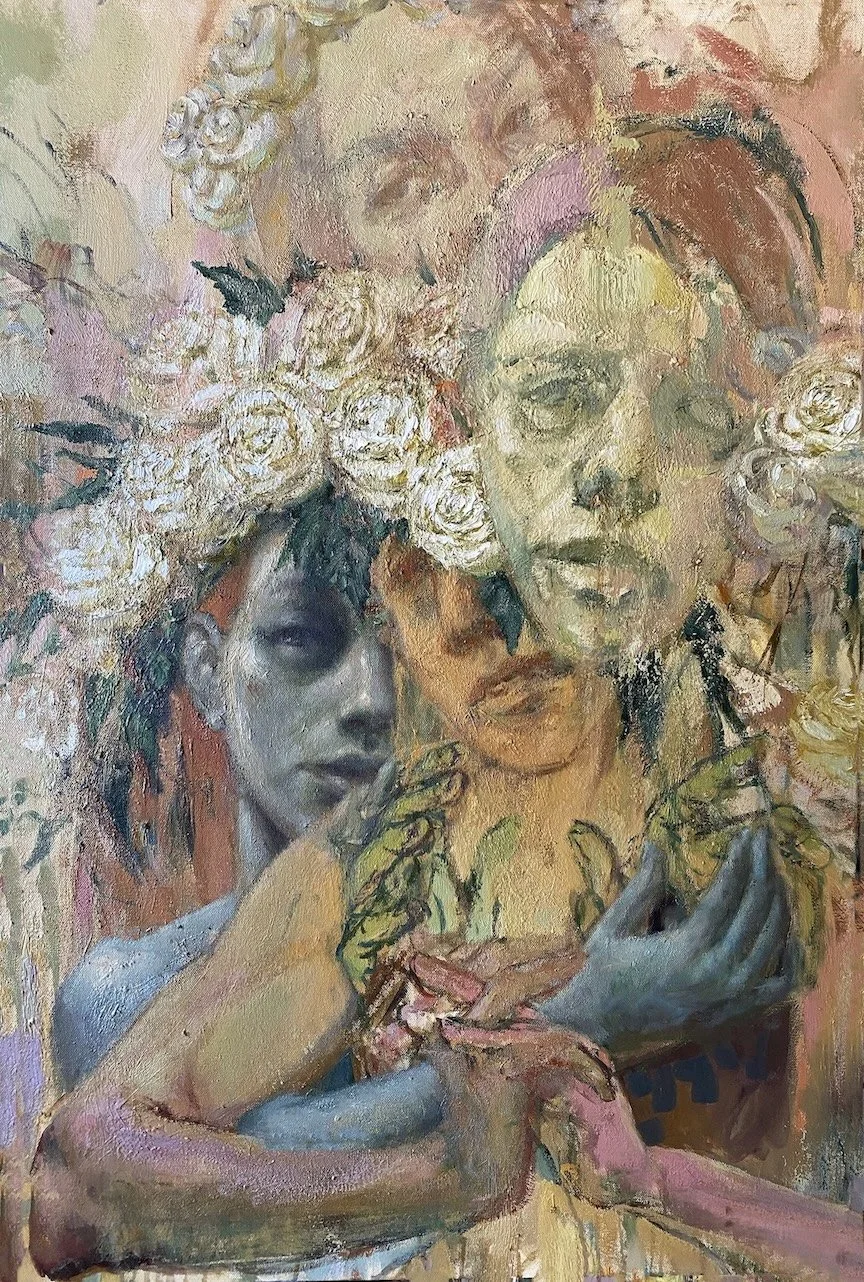
Fettered, 34” x 46”, oil on canvas
ML: Fettered is one of my many attempts to depict interiority that I mentioned earlier. I think a lot about how even if you haven’t seen a friend or family member in person for many years, they can occupy space in your frequent thoughts and dreams. They can even judge you as you go about your day. In Fettered, there are women impossibly close together in a non-logical mind space. An arm seems controlled by multiple faces just as in dreams one person can shift into someone else and we accept it in the dream logic world of our minds. The painting depicts women emerging out of an earthy monochromatic red, a color to depict a physical heart or blood, or to express strong emotions as red is generally used for in art.
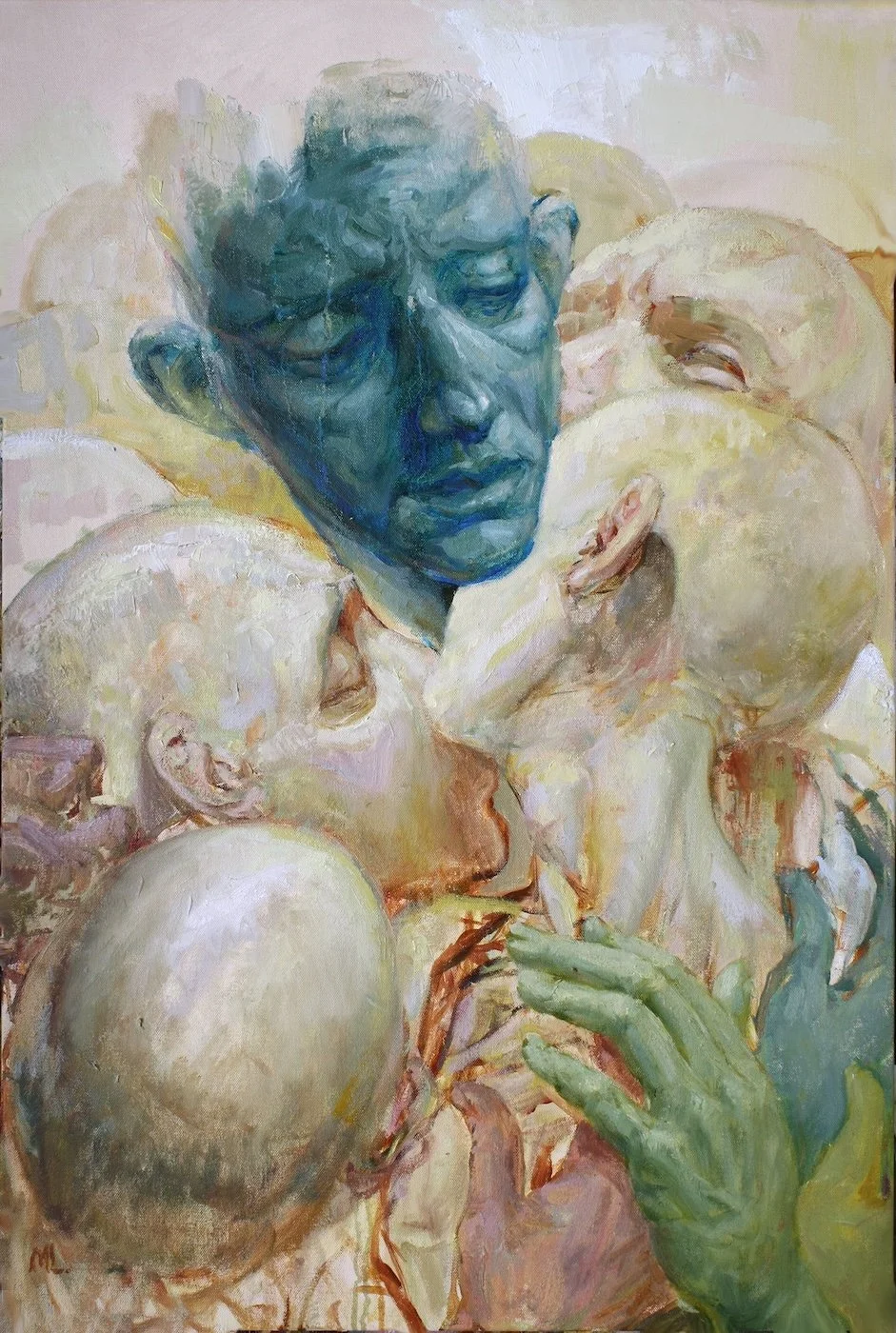
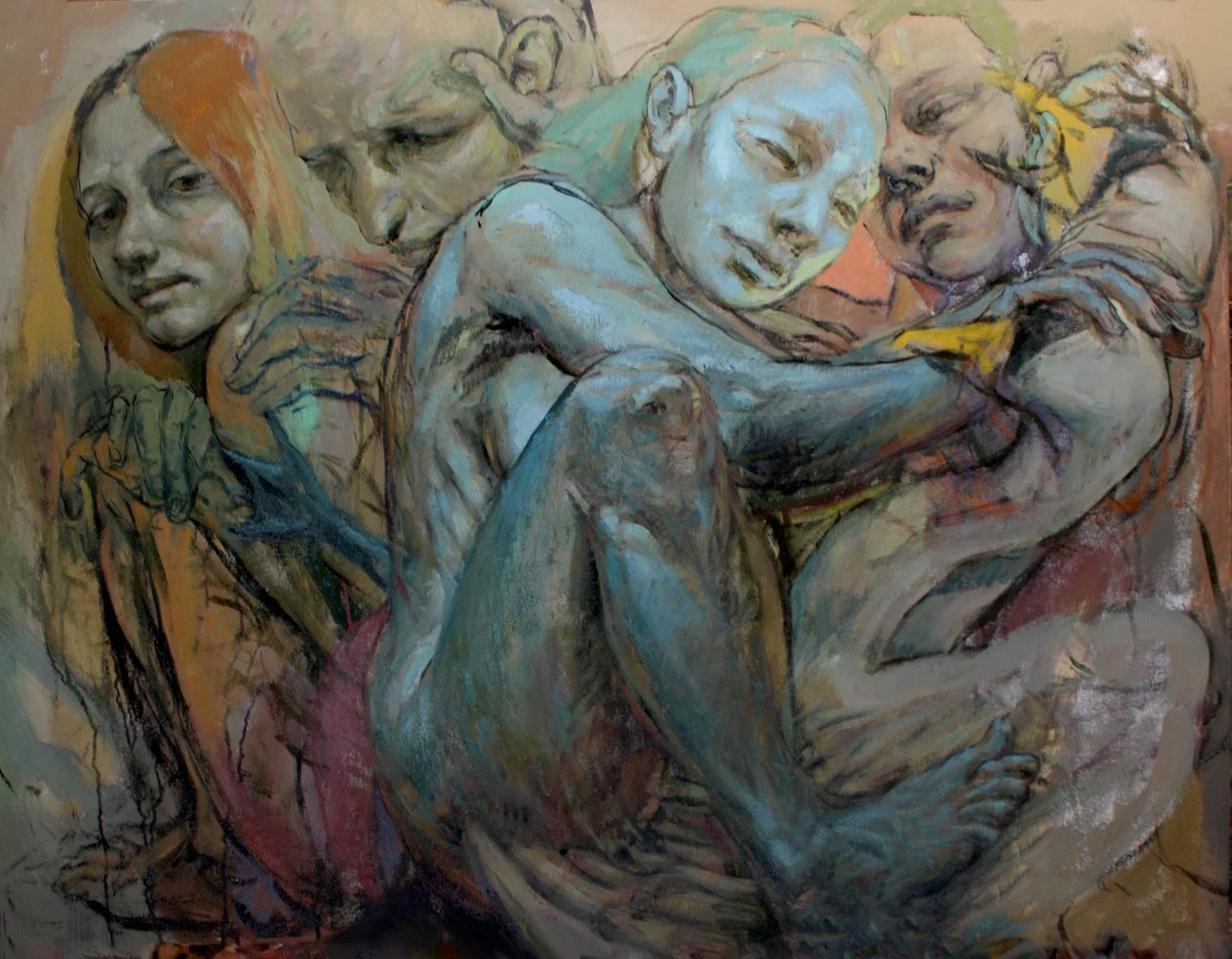
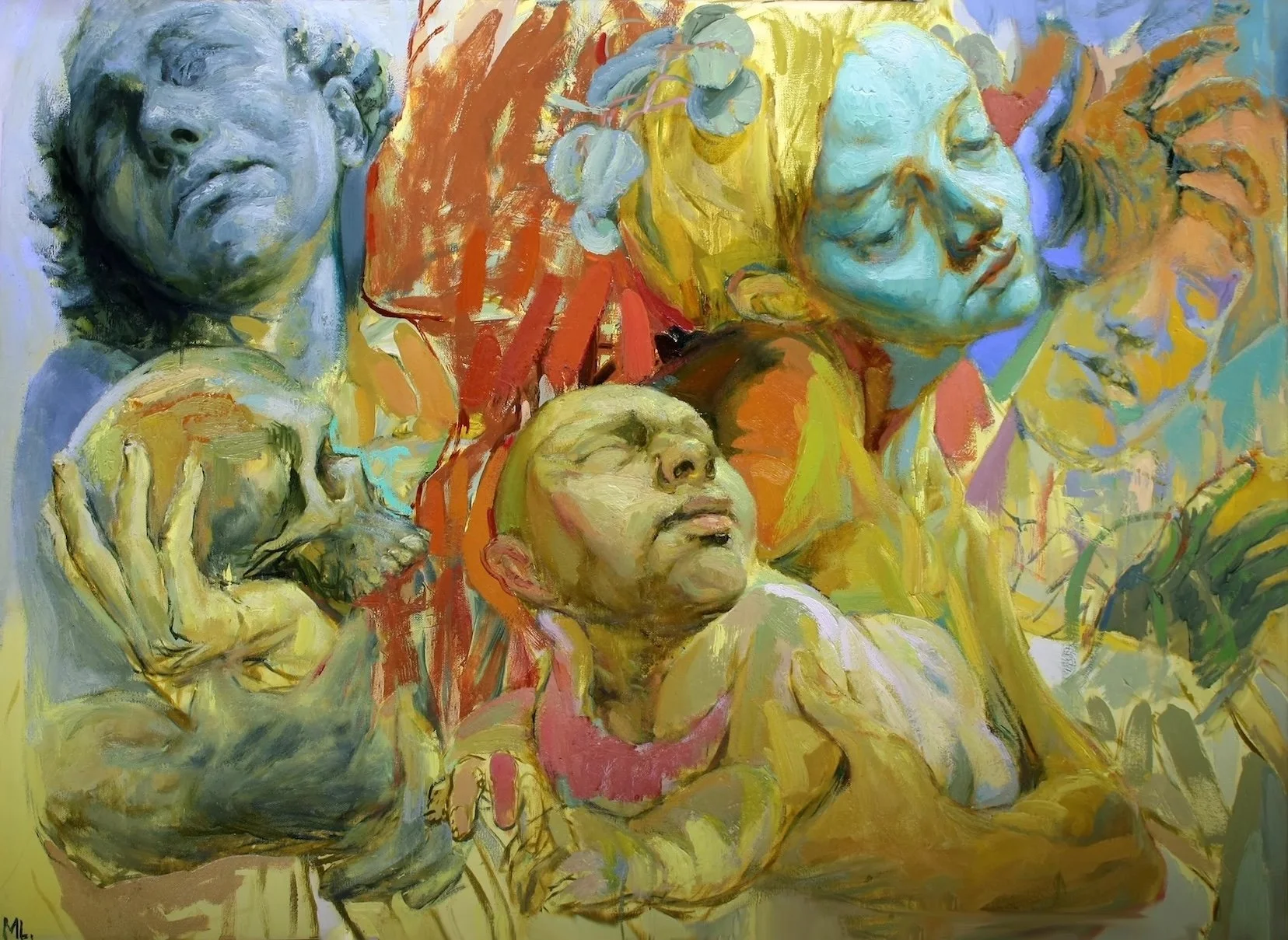
Heads II, 48” x 40”, oil on canvas
AAS: Do friends or family sometimes think they see themselves in your paintings that are not strictly portraits? I guess what I am asking is, are the faces in a painting like Heads II completely imaginary or composites of people you know?
ML: Yes, my friends and family do sometimes see themselves in my work and for good reason. I often depict loved ones in my paintings, though I don’t usually attempt to use reference and achieve the verisimilitude of a portrait. Another way to say it is that I am usually thinking about someone when I paint a face out of my head. In Heads II specifically, my wife, Marian appears on the top left (red-orange and yellow green face) and my good friend Ahmed appears down and to the right of her (red-orange face with a blue-violet ear) and is looking up at her. I like thinking about how we group the representations of certain people together in our minds and because we don’t usually remember people by their elbows or feet, the memory space is in some way a tower of human heads or maybe even faces.
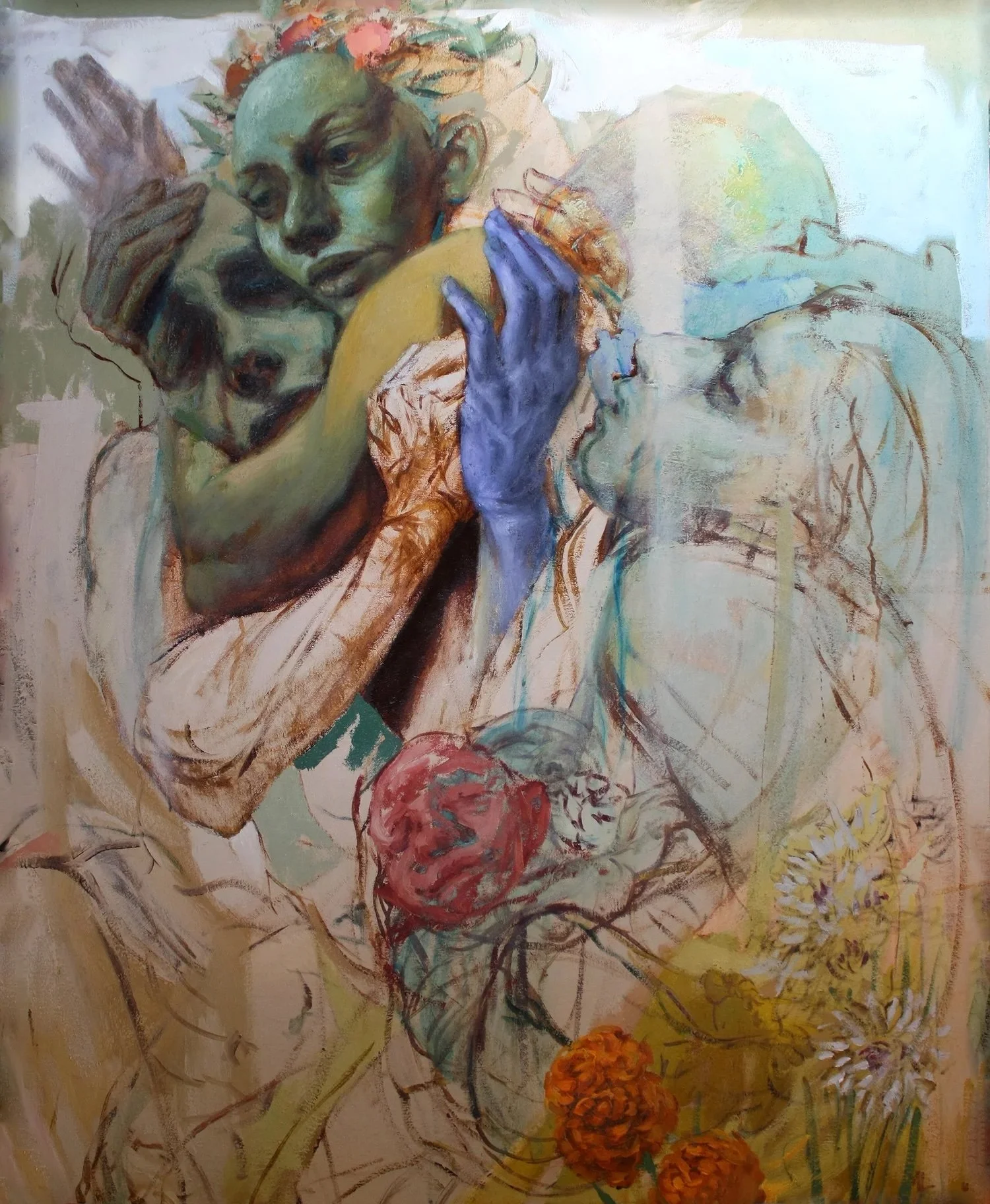
The Fit, 48”x 30”, oil on canvas
AAS: No matter what medium you are working in, there is always that balance of mystery, tension, and familiarity. In The Fit, I think it is the flowers! Congratulations on this one. And I bet your students have learned a lot from this painting.
ML: Thank you! Yes, the flowers grow out of the space and hang in the air and are symbols of fertility or lifeforce. I do discuss my works with my students sometimes, especially as an example if I am helping them write an artist statement or in a critique as they are learning to talk about a work they made that is not for a specific assignment.
I love that you said “that balance of mystery, tension, and familiarity” in your question. That is a great summation of what I am trying to achieve in many works including The Fit. These three are also at play in any serious relationship. In a strong relationship I think they activate and refine each other. In a dying relationship they become contradictory.
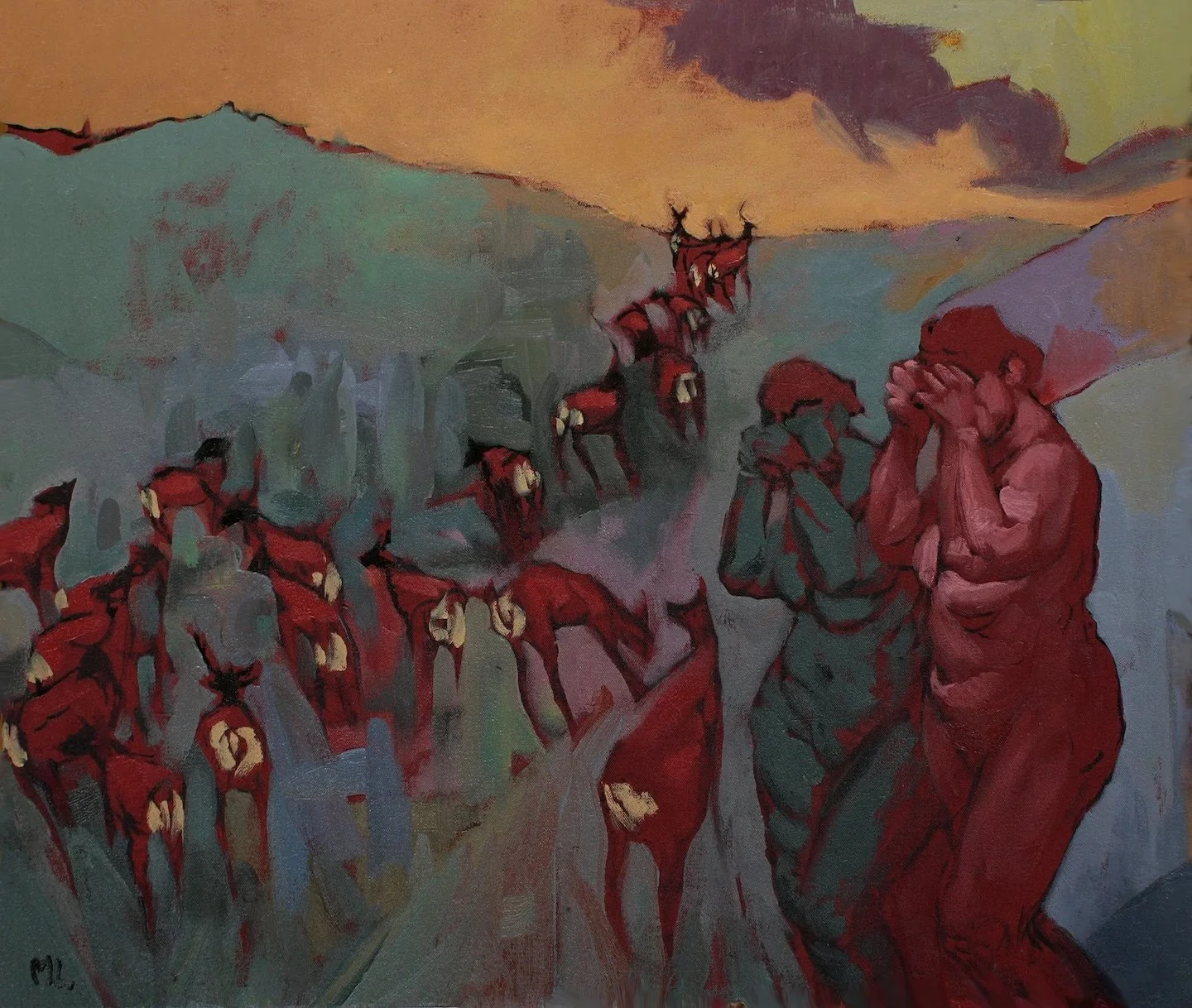
AAS: As much as I love The Fit, The Weight has to be my favorite. It really shows off your skills. Tell me about The Weight.
The Weight, 36” x 24”, oil on canvas
ML: The Weight was a portrayal of a specific depression I experienced within a few months of moving to Los Angeles. Being depressed in LA felt like a cruel joke. In Southern California it almost never rains. It is unrelentingly bright and sunny. It is usually around 70 degrees outside. Most people are unusually attractive and extraverted. When you are depressed there, you feel like it must be your fault!
The Weight in the title refers to the burden of a large man awkwardly perched on my shoulders showing me evidence of an infinitely creative universe. But I am looking away from the richness of the natural world — a young chimpanzee holding a python and birds that are often seen as beautiful and frequently kept as pets. I am struggling to hold up my portion of the beauty or even beginning to buckle under the weight of inspiration rather than channeling it.
AAS: You mentioned your brother is a musician. Have you worked in other art disciplines?
ML: I have tried many kinds of art over the years. Writing (poetry, lyrics, and a book), playing music (in bands and independently), making films (mostly comedy and horror with friends), and sculpture, though my 3D art was not made with being archival in mind and so is mostly gone or destroyed by now. Drawing and painting are the only arts I have enough formal training in to pull off with a consistent level of quality.
AAS: Do you have any special projects or shows coming up?
ML: I have had multiple visions of a painting series I am really excited about and have sketched out many of the compositions. I plan to complete three or four of them for a group exhibition in September at M2 Gallery in Little Rock.
AAS: What do you like to do when you are not painting or teaching?
ML: I am married with a seventeen-year-old stepson, a three-year-old son, and a ten-month-old daughter. In other words, I have no free time and very little, if any, down time. That said, I feel incredibly blessed because I lived alone for much of my young adulthood and though I had more freedom, I was also lonely and rudderless much of the time. These are my golden years even if I am always exhausted and occasionally falling apart.